
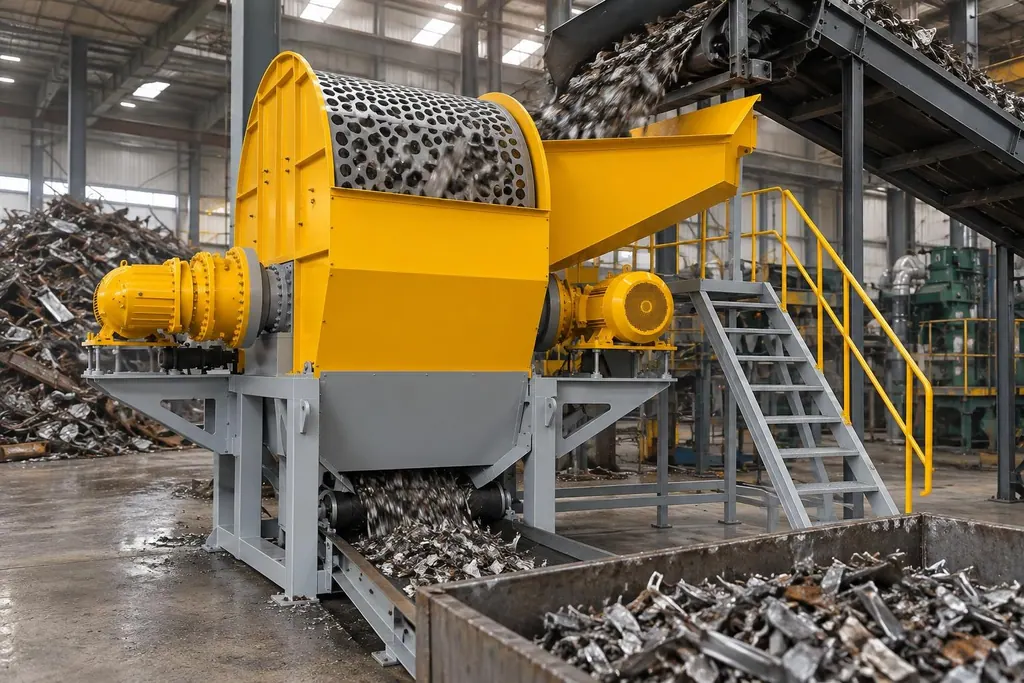
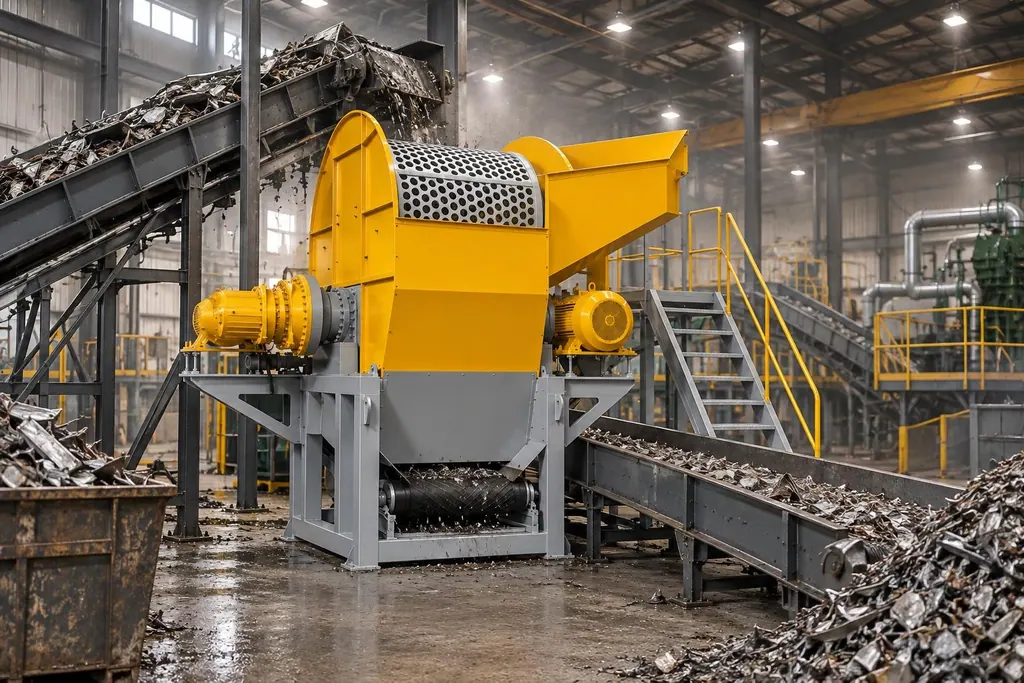
A Ferrous Metal Shredding Line handles size reduction and impurity liberation for car bodies, white goods scrap, and industrial steel waste. The machine uses a heavy-duty rotor spinning at high speed to drive hammers through impact, compression, and tearing actions, typically positioned upstream of recycling separation and remelting operations.
When processing scrap metal, rotor power and hammer structure dictate throughput capacity and specific power consumption per ton. Feeding light bales or complex structures directly into a single hammer mill causes sharp current spikes, screen blindings, and potential main shaft overload. Power dimensioning must be calculated based on feed resistance and bulk density rather than nominal nameplate capacity alone.
Wear part alloy chemistry and rotor configurations must match the degree of feed pre-shredding. Establishing clear process boundaries between primary tearing and secondary milling maintains continuous discharge while lifting metal recovery purity to over 98%.
| Equipment Type | Process Stage | Feed Material Profile | Power and Configuration Notes |
|---|---|---|---|
| Double-Shaft Shredder | Primary Shredding | Car bodies, bulky scrap, complex industrial solid wastes | Relies on low-speed high-torque shearing; heavy bearing assemblies and alloy blades absorb severe shock loads to prevent stalling |
| Hammer Mill | Secondary Fine Milling | Pre-shredded metal fractions, light scrap | High-speed rotor provides high-frequency impact energy; speed and hammer mass adjust to material hardness for liberation |
| Ferrous Metal Shredding Line | System-Level Processing | Mixed scrap metal, discarded appliances, industrial structural scrap | Upstream shredding controls feed geometry while the downstream mill homogenizes output; integrated magnetic and eddy current sorting recovers clean metals |
1. Evaluation Criteria for Rotor Drive Power and Torque Sizing in Scrap Metal Duties
Instantaneous resistance inside the crushing chamber varies erratically with scrap metal. Drive sizing must use peak shock torque as the hard sizing baseline instead of average running loads. For materials with high tensile strength and significant plastic deformation like car shells or industrial steel fabrications, the rotor requires sufficient rotational inertia to absorb impact energy and avoid motor tripping.
Feed geometry defines the hammer sweep envelope and overall power consumption. If structural sections enter the chamber while the drive is motorized only for light scrap, the rotor will stall immediately. The drive train requires closed-loop adjustment to track loads and trim crushing parameters, smoothing current spikes.
The discharge control assembly directly changes energy utilization inside the chamber. When bottom grates are fitted, smaller apertures keep material circulating longer under repeated strikes, which multiplies power draw. When the target is size control for downstream smelting, adjusting the material flow path with defined discharge clearances eliminates wasted power from material entrapment.
2. Criteria for Matching Wear Hammer Alloys and Geometries to Feed Bulk Density
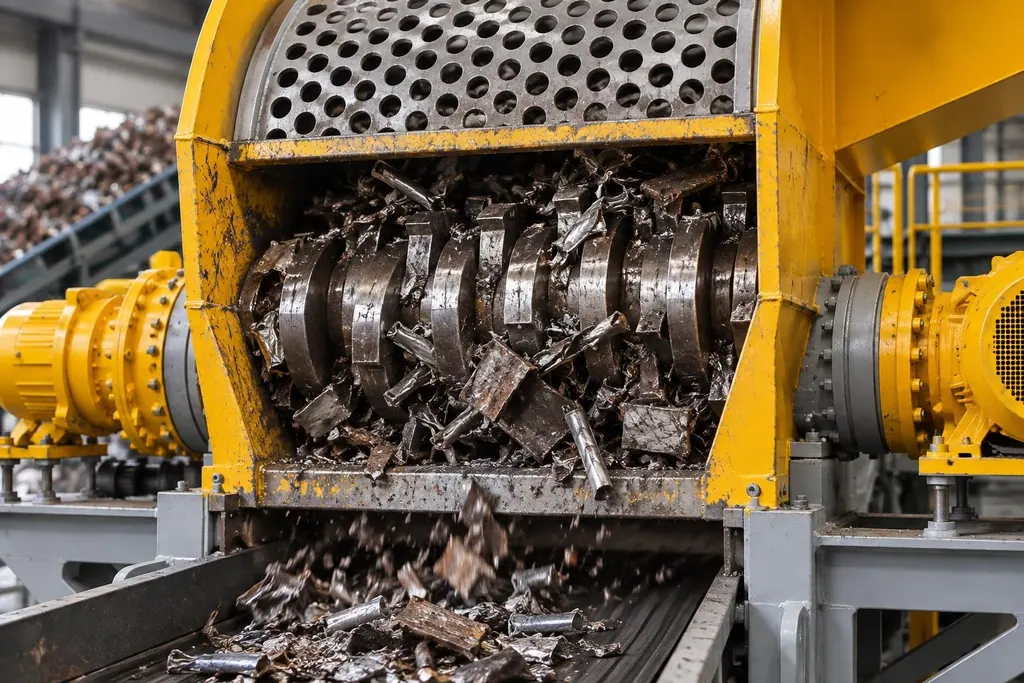
Hammer material and profile selection depends on the balance between impact severity and abrasive wear. For large structural pieces such as automotive bodies, hammers endure severe impact shear upon feed entry. These conditions demand specialized high-strength alloy hammers supported by a tough matrix to prevent fatigue fractures under high-frequency impact.
For fine, highly abrasive inputs such as industrial metal turnings, selection shifts toward surface wear life. Rotors for this duty should feature specialized composite wear-resistant hammers, using hardened surfaces to resist gouging and delay striking face deformation.
Hammer mass dictates kinetic impact energy. Processing light sheet metal structures calls for low-drag lightweight alloy hammers to maintain peripheral tip speed. For heavy scrap bales, operators must switch to massive single-piece cast alloy hammers that deliver high strike impact to break open the metal and secure proper tearing.
3. Layout Logic for Upstream Pre-Shredding and Downstream Milling Efficiency
Installing a Double-Shaft Shredder upstream on a high-capacity Ferrous Metal Shredding Line absorbs the impact load otherwise placed on the downstream hammer mill. The Double-Shaft Shredder uses interlocking alloy blades operating at low speed and high torque to shear full vehicle shells or bulky items, opening enclosed cavities and releasing internal tension.
Primary shredding turns three-dimensional weldments into flat shredded shreds. As these drop into the hammer mill, the high-speed rotor no longer sees severe localized shock loads. This balanced stage reduction produces uniform metal fragment sizes for downstream magnetic separation and lowers remelting energy consumption by 20%.
Processed material discharged to high-intensity magnetic separators and eddy current sorters delivers metal recovery purity above 98% while isolating light fraction contaminants. Distributing the mechanical load across the whole line protects blades and hammers from edge chipping while maintaining target output rates.
Machine in Action
FAQ
- Why is a standalone hammer mill discouraged for mixed bulky scrap metal?
- Unprocessed whole auto shells and heavy industrial structures have high structural integrity. Feeding them directly into a hammer mill causes instantaneous peak torque overloads, severe dynamic shaft loads, and accelerated hammer wear. Pre-shearing with a Double-Shaft Shredder at low speed releases stored elastic stresses, allowing the secondary hammer mill to operate under stable loads.
- How should wear hammer alloys be selected on a scrap metal recycling line?
- Breaking large structural scrap involves heavy impact loads, requiring specialized alloy tools and hammers with high impact toughness to prevent brittle failures. For abrasive tasks like metal turnings, specialized composite wear-resistant materials should be selected to resist gouging and reduce replacement downtime.
- How does the recycled metal processed by this line perform in downstream applications?
- Material processed through initial shredding and hammer milling achieves a uniform scrap size. Downstream magnetic and eddy current units then isolate clean metals to a recovery purity above 98%. These liberated fragments melt efficiently, reducing remelting energy demand by 20%.