
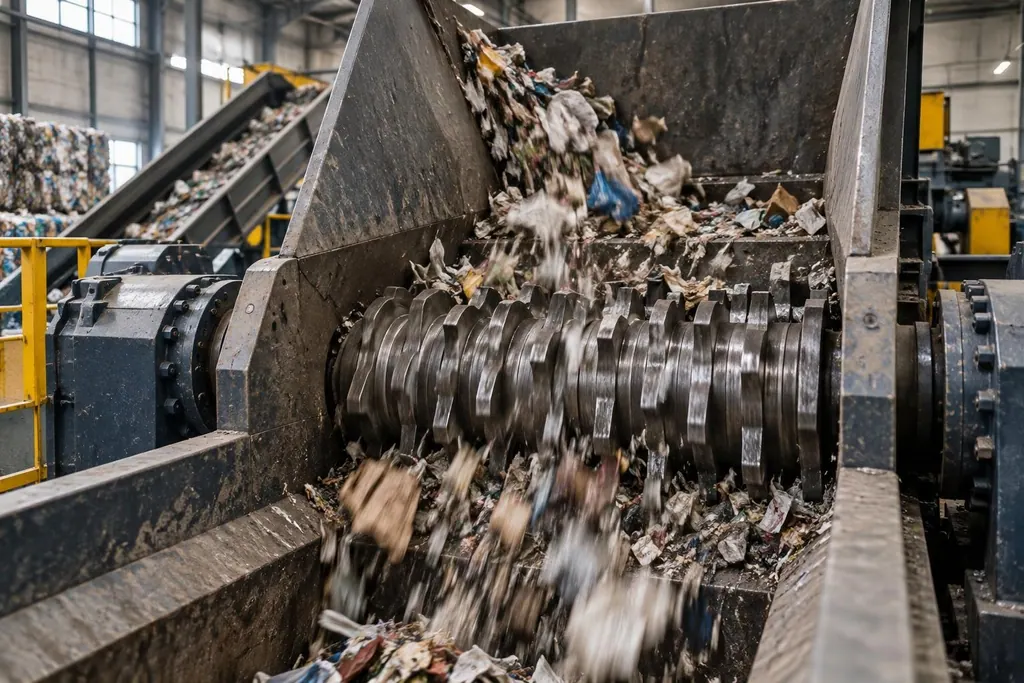
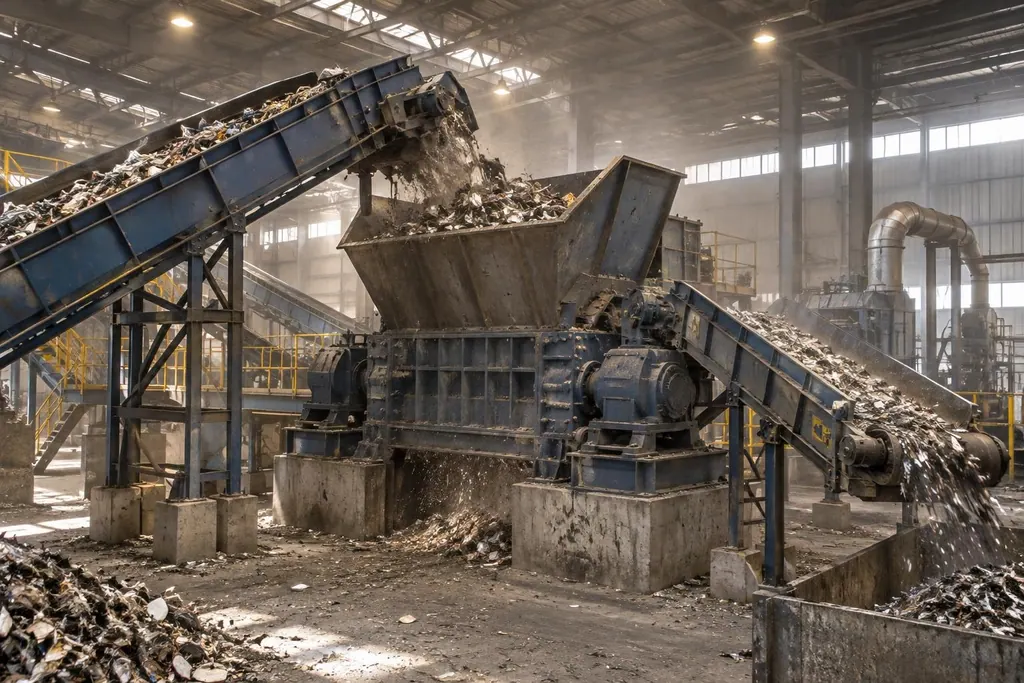
The Double-Shaft Shredder operates in the primary crushing and volume reduction sections of a Ferrous Metal Shredding Line. Two counter-rotating shafts drive staggered alloy blades, cutting car shells and industrial scrap steel into uniform fractions through shearing, tearing, and compression.
Mixed scrap metal composition varies widely, frequently containing medium-to-thick plates, structural members, and wrapping contaminants. Equipment sizing depends on material thickness and structural rigidity. Bulky thin-sheet bales or vehicle bodies tend to cause instantaneous blockages, requiring a Double-Shaft Shredder fitted with aggressive shearing edges. Solid thick sections must be diverted to heavy-duty drop sections to prevent blade chipping.
Within a Ferrous Metal Shredding Line, the Double-Shaft Shredder performs primary liberation. The shredded fractions show higher dimensional uniformity, which simplifies downstream separation and refining, cuts smelting power consumption by 20%, and reduces wear on secondary machines.
| Equipment Type | Target Feed | Process Function | Sizing Criteria |
|---|---|---|---|
| Double-Shaft Shredder | Car shells, industrial scrap steel, WEEE scrap | Primary crushing and volume reduction | Selected for bulky, entanglement-prone scrap; utilizes low-speed, high-torque shearing and tearing to prevent blockages |
| Ferrous Metal Shredding Line | Demolition waste, mixed scrap metal | Complete line shredding, separation, and refining | Selected for simultaneous output of clean ferrous and non-ferrous metals; paired with downstream magnetic and eddy current units |
1. Mixed Scrap Metal Characteristics and Double-Shaft Shredder Working Principles
Dismantled vehicle scrap and industrial scrap metal combine light sheet metal, high-strength reinforcement beams, and plastic trim. Feeding this directly into impact fine crushers causes light fractions to ball up, while hard unshreddable items accelerate hammer wear.
The Double-Shaft Shredder utilizes a dual-rotor design. Both blade shafts rotate inward at low speeds. The intermeshing alloy blades exert shear and tensile forces when grabbing bulky feed, tearing apart metal parts of varying tensile strengths. This mechanical configuration increases processing efficiency by over 40% compared to legacy crushing methods.
Installing this unit at the front end reduces bulkiness and pre-slits the material. Once metal bales are torn and cut, inner voids collapse, releasing trapped non-metallic contaminants for cleaner liberation before feeding into downstream Eddy Current Separator and Magnetic Separator units. Sizing depends on bale density and tramp content: dense bales require high-torque drives, whereas loose thin-gauge scrap demands tighter blade hook spacing for reliable intake.
2. Shear Blade Materials and Hook Profiles
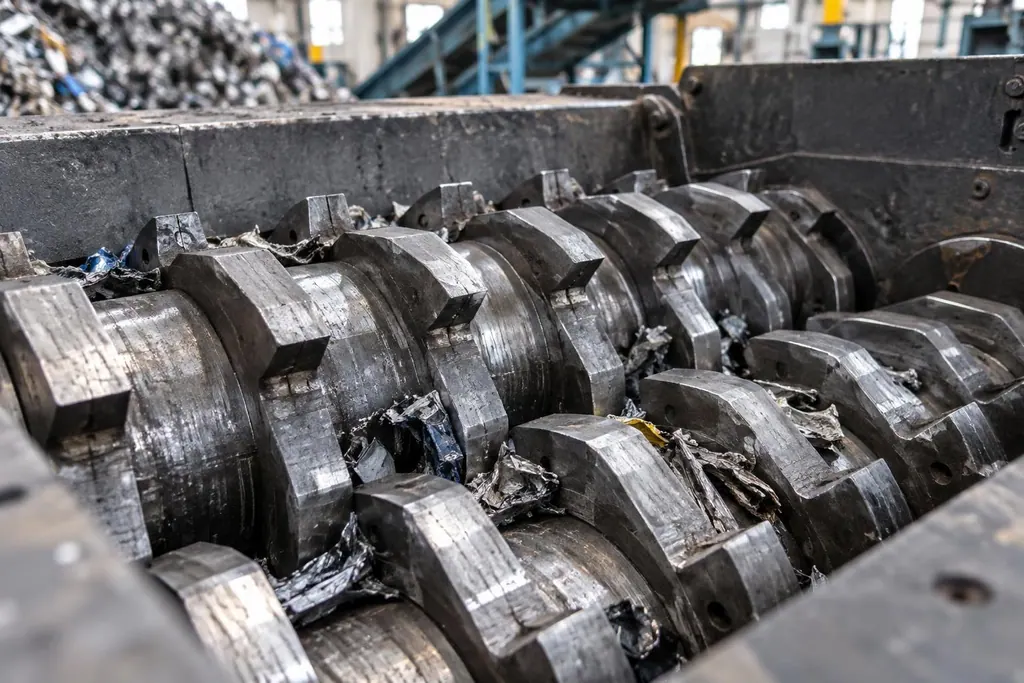
Rotor blades absorb direct impact and abrasive wear. Blade geometry selection depends on wall thickness and deformation resistance of the scrap feed. Slippery car bodies and curled sheets require multi-hook blades for aggressive intake. High-strength industrial scrap steel calls for thick single-hook or double-hook profiles to maintain root bending strength.
Special alloy blades work alongside heavy-duty bearings and gearboxes to absorb cyclic shock loads. Material is sheared and crushed inside the cutting chamber. If blade clearance widens from wear, thin sheets bend into the gaps rather than shearing cleanly, which quickly leads to rotor stalling.
Wear-resistant alloy blades preserve continuous cutting edges. Paired with electrical monitoring that tracks loads in real time, the system regulates shredding cycles automatically, raising throughput by 30% while reducing blade wear.
3. Low-Speed High-Torque Jam Prevention and Overload Protection
Mixed scrap steel frequently conceals uncrushable solid shafts or oversized cast iron sections. Without driveline damping, sudden shock loads transfer straight to gearboxes and motors, fracturing gear teeth or burning out motor windings.
Processing mixed metals requires overload protection at the drive end. When unshreddables jam the cutting chamber, rotor current surges and torque exceeds preset thresholds. The PLC cuts forward rotation immediately and engages reverse mode, expelling the jammed feed before resuming forward cuts. Sizing depends on contaminant hardness and the likelihood of uncrushables: more variable feeds require higher reverse torque and faster overload response.
If repeated forward and reverse cycling fails to clear the jam, the machine triggers an alarm, halts operation, and opens the service door for manual clearing. This prevents prolonged loaded stalling on the rotor assembly.
FAQ
- What types of mixed scrap metal can a Double-Shaft Shredder process?
- This machine processes complex materials including car bodies, industrial scrap steel, and discarded household appliances. Intermeshing alloy blades apply shear, tear, and compression forces to reduce bulky scrap into uniform, downsized fractions.
- How does the cutting chamber prevent stalling when encountering uncrushable hard items?
- The system incorporates intelligent monitoring and overload protection logic. When torque exceeds set limits, the rotor shafts automatically reverse to disengage the material and then resume forward cutting. If the resistance persists after multiple cycles, the unit shuts down automatically to protect the gearboxes and bearings.
- What downstream equipment typically follows a Double-Shaft Shredder in a Ferrous Metal Shredding Line?
- After primary reduction in the Double-Shaft Shredder, scrap transfers to secondary fine crushing or separation stages. The complete line typically incorporates a Magnetic Separator to recover ferrous metals and an Eddy Current Separator with high-frequency alternating magnetic fields to extract non-ferrous metals, reaching recovery purities above 98%.