
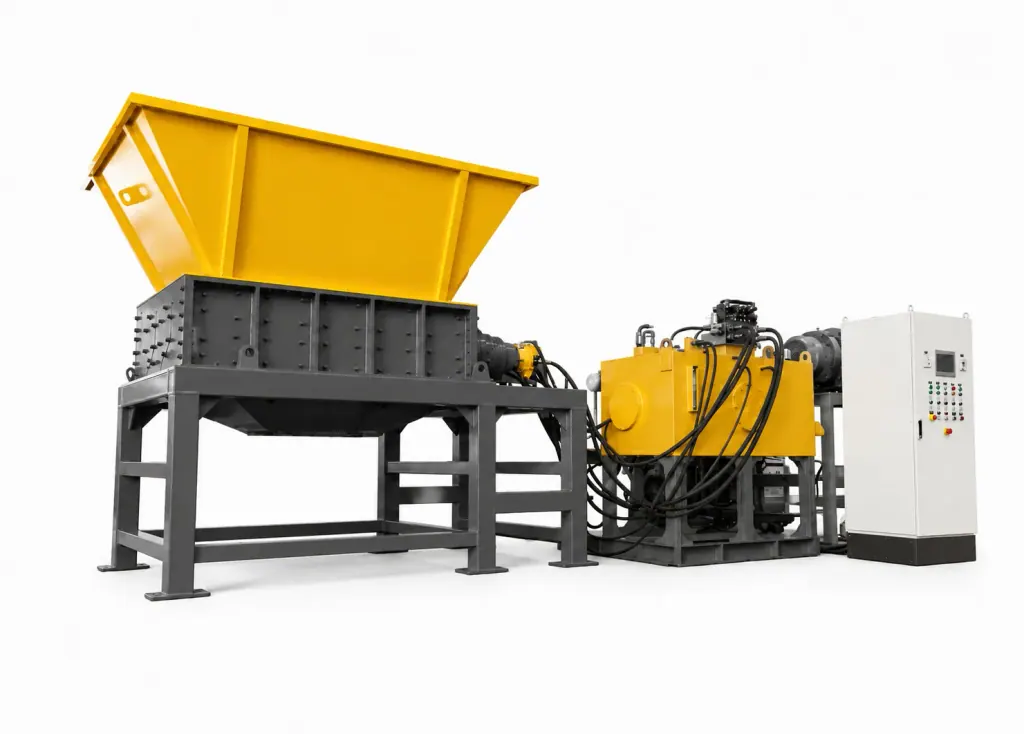
A Hydraulic Shredder is commonly placed at the front end of a Waste Cable Recycling Line for primary breakdown. Driven by a low-speed, high-torque hydraulic motor, its alloy blades process mixed wires and power cables wrapped in steel tape armor, steel wire braiding, and tough outer sheathing.
Tightly bundled cables demand sufficient torque reserve and shock absorption. Mechanical drives handling thick armored cable risk hard stalls or broken gear teeth. By regulating oil pressure and displacement, a hydraulic system maintains high torque output at low rotational speeds, shearing directly through outer metal casings and inner cores.
Equipment evaluation centers on three factors: hydraulic reversing response, interlocking blade spacing, and auto-reverse logic under stall conditions. Nameplate motor power alone is insufficient. The main criterion is whether the hydraulic motor can sustain peak pressure to complete the cut during a rotor jam, or dump pressure immediately to prevent line bursts if uncuttable.
| Equipment Type | Applicable Materials | Process Stage | Selection Criteria |
|---|---|---|---|
| Hydraulic Shredder | Armored cables, baled automotive wire harnesses, heavy industrial cable | Primary breakdown pretreatment | Relies on low-speed high-torque hydraulic motors to cut steel armor; includes hydraulic overload auto-reverse protection |
| Double-Shaft Shredder | Coiled industrial wire, bulk multi-strand mixed wire | Primary volume reduction shearing | Staggered alloy knives provide multiple shear points for higher throughput; driven by mechanical gearbox |
| Waste Cable Recycling Line Fine Granulation Unit | Pre-shredded short cable segments | Secondary fine sizing | Reduces pretreated cable lengths to target size for downstream separation of copper, aluminum, and plastics |
1. Armored Cable Properties and High-Torque Drive Sizing
Steel armor and heavy copper conductors in scrap cable generate high shear resistance. Forcing cuts with a standard mechanical gearbox causes shock loads that stress shafts and gearcases. A hydraulic drive uses relief valves to vent excess pressure, absorbing severe impact during cable deformation.
Configuration begins with incoming steel tape thickness and cable diameter. When feed material includes heavy armored power cables or bound automotive harnesses, select a unit with a high-displacement radial piston motor to crush open metal sheathing at low speeds. For fine, loose wires lacking structural rigidity, lower system displacement and increase rotor speed to build throughput through cutting frequency.
The primary goal of an upfront Hydraulic Shredder is volume reduction and untangling dense coils. Slicing long cables into short segments prevents bridging in downstream granulators and air separation tables.
2. Rotor Profile Design and Anti-Wrapping Wear-Resistant Tooling
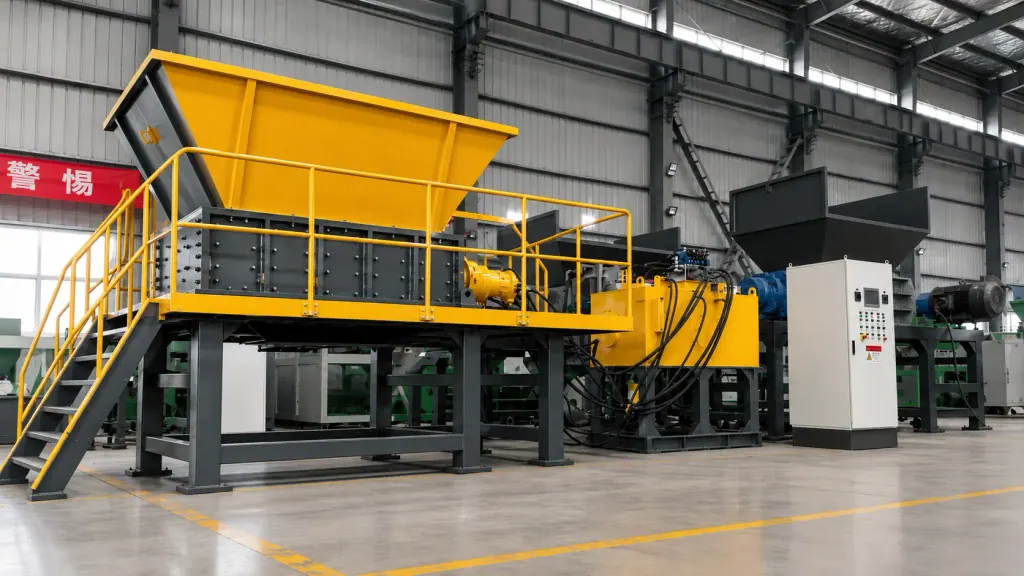
Long cables dumped into the hopper tend to wrap around the shaft, increasing bearing loads and wearing out shaft seals. Rotors generally use polygonal cross-sections with staggered knives, where rotating cutting edges mesh tightly with stationary counter-combs to shear cables cleanly and prevent flexible insulation from pulling into gaps.
Blade thickness and tooth counts depend on incoming cable diameter. For armored cables, hook profiles must grab stock firmly, and knife bodies require sufficient thickness to resist lateral deflection and edge chipping. When handling rubber jacketing or fine stranded copper, run tight blade clearances so flexible jackets do not pack into clearances and cause stalls.
Blade materials must handle both impact and abrasion. Slicing steel armor causes high wear. Selection requires verifying the base metallurgy and checking whether cutting edges accept hardfacing repairs or use indexable inserts, which dictates long-term consumable costs.
3. Constant-Power Variable Displacement and Overload Auto-Reverse Logic
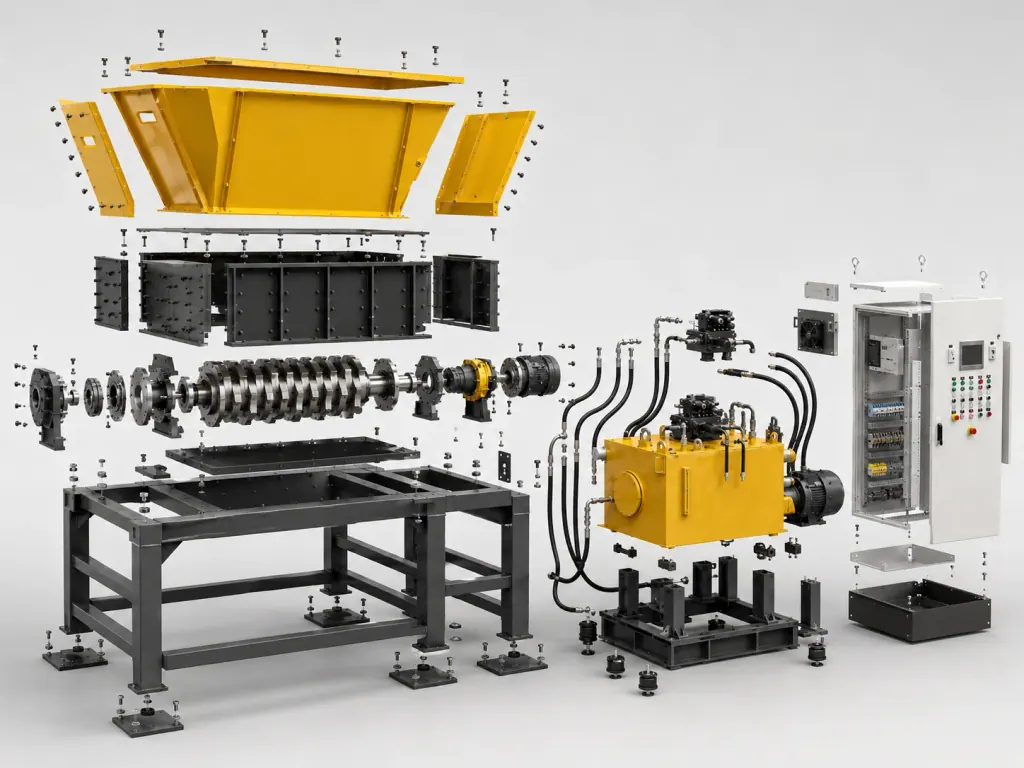
Grab feeding creates uneven loading. Dropping large bundles into the hopper spikes system pressure instantly. The control system tracks line pressure; once resistance nears the relief limit, a proportional variable-displacement pump reduces output flow, maintaining full torque at lower speed under rated power to finish the cut.
Uncuttable tramp iron or dense knots require immediate reversal to clear the chamber. High pressure signals trigger the directional valve, reversing the rotor to break apart the mass before returning to forward rotation. If the obstruction remains after preset reverse attempts, the unit stops and trips a fault alarm to protect the rotor and main pump.
Controls must be evaluated for smooth reversal action and parameter flexibility based on feed stock. The Hydraulic Shredder control cabinet must interlock with the upstream apron feeder: the moment the shredder reverses to clear a jam, the feeder stops, restarting only when normal chamber operation resumes.
FAQ
- Can a Hydraulic Shredder directly process scrap cable with steel wire braid or steel tape armor?
- Yes. The hydraulic motor delivers low-speed, high-torque power to shear steel armor using heavy blade profiles, while circuit relief valves absorb shock without the broken shafts seen in rigid mechanical gearboxes.
- How do you determine whether the front end of a Waste Cable Recycling Line should use a hydraulic drive or a mechanical gearbox?
- Selection depends on incoming material. For heavy steel armor, thick rubber sheathing, and tightly coiled cable bundles, a hydraulic drive is the safer choice. For uniform feeds of loose mixed wire and light-jacketed cable, a mechanical gearbox shredder offers lower capital cost.
- How does the electrical control system handle a stall in a Hydraulic Shredder during cable processing?
- When circuit pressure exceeds the set limit, sensors signal the infeed conveyor to stop, and hydraulic valves reverse the rotor to expel material. After two to three reverse turns, the rotor returns to forward rotation; if the cut fails three times consecutively, the machine shuts down and triggers an alarm.