
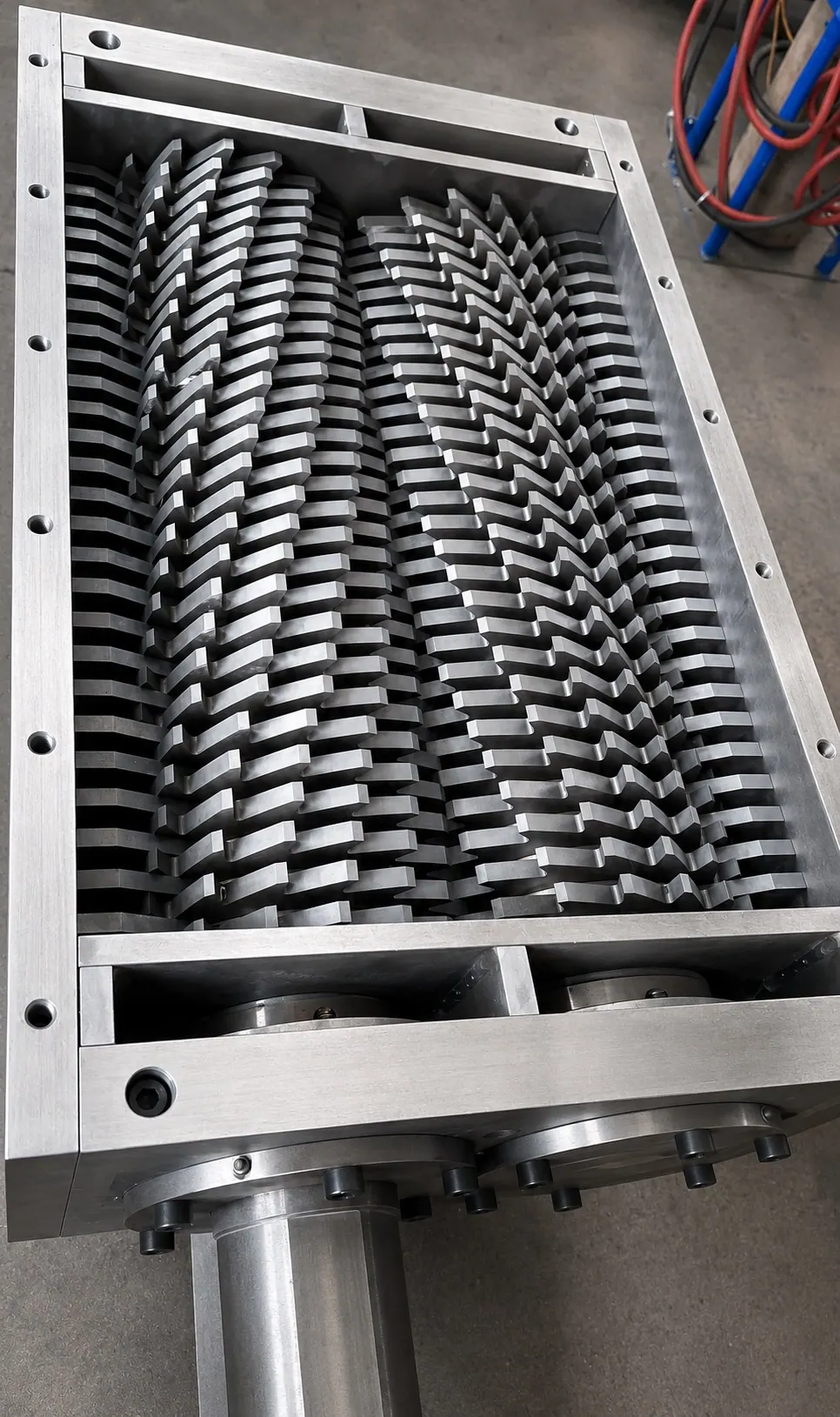
With the accelerating global demand for renewable green energy, converting sawdust, wood shavings, crop stalks, and agro-forestry residues into high-density biomass fuel pellets has become an essential approach to resource recovery and waste valorization. As the core densification equipment in any complete pelleting facility, the industrial Biomass Pellet Machine (vertical ring die pellet mill) directly dictates the operating throughput, pellet durability, and overall economic return of the Biomass Pellet Production Line.
Working Principle and Densification Mechanism of Ring Die Pellet Mills
A heavy-duty vertical ring die Biomass Pellet Machine mainly consists of a main drive motor, heavy-duty reduction gearbox, ring die, press rollers, and a forced mechanical feeding assembly. Pre-conditioned biomass feedstock with optimized particle size (≤ 6mm) and moisture content (10%-15%) drops vertically into the pelleting chamber. Driven by high centrifugal force, material distributes uniformly across the inner circumference of the stationary ring die. The heavy-duty press rollers rotate inside the die, generating massive mechanical compression and frictional heat. Under intense heat and pressure, natural lignin within the plant fibers softens and plasticizes, functioning as an inherent binder. The compacted biomass is extruded through the precision die channels into dense cylinders, which are then trimmed to uniform lengths by external cutoff knives to produce high-density fuel pellets.
Three Core Engineering Advantages of Industrial Ring Die Pellet Mills
Compared to traditional flat die pelletizers, industrial vertical ring die machines provide superior structural resilience for continuous, large-scale fuel pelleting:
• High-Efficiency Direct Gear Transmission: Engineered with precision hardened-tooth bevel gears delivering over 98% mechanical transmission efficiency, cutting specific energy consumption far below standard belt-driven configurations.
• Vertical Dual-Layer Ring Die with Centrifugal Feeding: The vertical drop combined with centrifugal spreading prevents feedstock buildup and bridging. The dual-layer ring die design allows top-and-bottom inversion, effectively doubling service life per wear set.
• Continuous Circulating Lubrication and Dust Sealing: Integrated with an automated circulating thin-oil lubrication and active heat-dissipation circuit, ensuring the main shaft bearings and roller assemblies remain continuously lubricated and cooled under severe high-pressure continuous runs.
Key Parameter Selection Guide for Biomass Pellet Densification
When tailoring equipment for hardwood, softwood, straw, or peanut hulls, plant operators must evaluate four critical technical parameters:
1. Compression Ratio Optimization: The effective length-to-diameter (L/D) ratio of the ring die channels determines pellet density. Hardwood sawdust typically requires a ratio of 1:4.5 - 1:5.5, whereas high-fiber agricultural straw demands 1:5.5 - 1:6.5.
2. Throughput Capacity and Motor Sizing: Single-unit throughput spans from 1.5 t/h to 4.0 t/h, powered by heavy-duty motors ranging from 90kW to 220kW. Motors must be sized with adequate torque reserves matching targeted hourly plant capacity.
3. Metallurgical Grade of Die and Rollers: Prioritize alloy structural steels (such as 20CrMnTi) or high-chromium stainless steel forgings treated with vacuum quenching to withstand severe abrasive wear.
4. Upstream Drying and Size-Reduction Balance: Consistent densification relies strictly on upstream hammer mills and rotary drum dryers delivering uniform particle distribution and tightly stabilized ~12% moisture.
Typical Process Flow and Layout in a Complete Biomass Pellet Production Line
A comprehensive Biomass Pellet Production Line integrates: raw log/scrap pre-chipping → hammer mill fine pulverization → rotary drum drying → dry surge bin buffer storage → vertical ring die Biomass Pellet Machine densification → counterflow pellet cooler temperature reduction → vibrating screener fines separation → automated bagging and palletizing. Installed upstream of cooling and bagging, the Biomass Pellet Machine serves as the critical choke point governing overall pellet integrity, bulk density, and plant profitability.
Biomass Pellet Mill Maintenance & Troubleshooting FAQ
Q: What causes low pellet density, loose structural binding, or surface cracks? A: This is most commonly caused by excessive feedstock moisture (>15%) or an undersized die compression ratio. Reducing incoming moisture content or installing a higher-ratio ring die will immediately restore pellet hardness and smooth surface finish.
Q: How can we minimize accelerated wear on ring dies and roller shells? A: Always install strong magnetic separators and vibrating destoner screens before size reduction to intercept tramp metal, rocks, and abrasive grit. Maintain regular automated grease delivery to protect bearing assemblies from fine dust contamination.
Q: Can freshly cut green wood branches or wet field straw be fed directly into the machine? A: No. Wet or coarse materials will clog the die channels, trigger severe steam buildup, and overload the drive motor. Feedstock must undergo primary chipping, secondary hammer milling, and drum drying down to 10%-15% moisture before entering the pelleting chamber.