
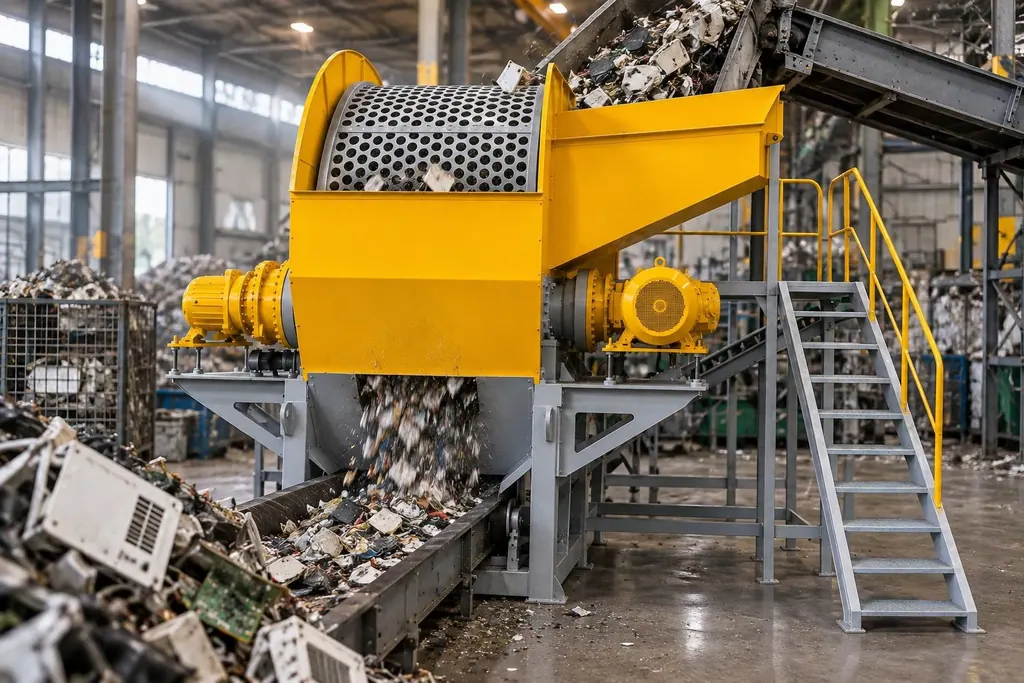
Double-Shaft Shredder units operate in the primary coarse shredding stage of a WEEE Recycling Line. Intermeshed alloy blades on two counter-rotating shafts run at low speed and high torque. Shearing, tearing, and crushing forces break down refrigerator, washing machine, and air conditioner casings and internal parts into loose material ready for downstream magnetic and eddy current separation.
WEEE scrap contains an unpredictable mix of materials. Sheet steel and engineering plastics are intermingled with motor rotors, solid shafts, and polyurethane insulation foam. If the shaft system or blade profile does not match the feed, the main shafts stall easily, and blade hooks slip or wrap with material.
Drive capacity, hook geometry, and anti-jamming controls must reflect the structural stiffness of the incoming scrap and downstream sizing requirements. Sizing comes down to finding the balance between intake efficiency and impact resistance.
| Machine Type | Core Configuration | Applicable WEEE Scrap Conditions | Selection Criteria |
|---|---|---|---|
| Double-Shaft Shredder | Few-hook thick blades with low-speed heavy-duty gearbox | Undismantled refrigerators, air conditioner housings, and scrap containing motors | Large hollow sheet metal demands deep hook reach for feeding, prioritizing shaft impact toughness |
| Double-Shaft Shredder | Multi-hook medium-thin blades with contoured spacers | Pre-flattened washing machine panels and television plastic housings | Flat, uniform material requires higher cut frequency per revolution and narrower strip widths for sorting |
1. Torque and Shaft Rigidity Requirements for Mixed WEEE Scrap
Processing light sheet metal mixed with solid metal demands an understanding of deformation resistance under load. Refrigerator and washing machine casings are bulky yet thin-walled. Blades must pierce and flatten these housings upon entering the cutting chamber, but when a compressor base or motor is pulled in, the shaft system must deliver peak torque instantly.
Sizing the motor solely on the average load of sheet metal causes stall-outs and shaft breakage against solid steel components. A direct drive with heavy-duty bearings and a gear reducer is required to maintain steady shearing force, enabling the main shafts to withstand lateral cantilever bending moments.
The chassis and bearing housings must have ample rigidity reserves. Unbalanced forces from mixed feed subject the shaft assembly to continuous alternating shocks. Inadequate stiffness leads to misalignment and interference between static and counter knives.
2. Hook Count and Blade Thickness for White Goods Shredding
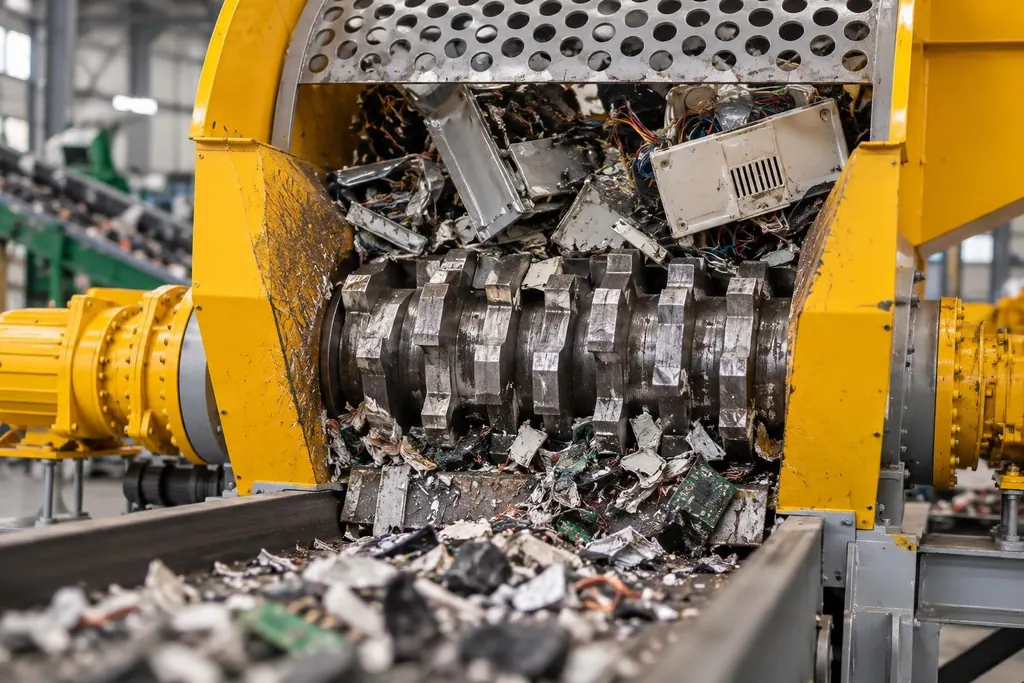
Hook count dictates whether the Double-Shaft Shredder relies on aggressive grabbing or dense shearing cuts. For large hollow housings, single-hook or double-hook blades with deep hook profiles pull smooth cold-rolled steel and ABS panels directly into the cutting zone.
For smaller, rigid feed, blades with too few hooks let material slip through without engaging, causing idle rotations. Selection depends on hollow scrap volume. Intact appliances require thick blades with fewer hooks for aggressive intake. If scrap is pre-flattened or roughly dismantled, multi-hook thinner blades raise the cutting frequency.
Blade thickness directly sets the discharge strip width. Excessively thick blades produce oversized chunks where metal remains wrapped around plastic, reducing magnetic separation efficiency. Excessively thin edges chip easily when striking cast iron parts, so impact strength sets the lower limit for blade thickness.
3. Anti-Jamming Shaft Design and Overload Protection for Pre-Shredding
Uncrushable tramp metal inevitably enters appliance recycling streams. Managing blockages requires millisecond-level current monitoring and automatic reversal programming in the control cabinet.
When motor current exceeds the limit, the system stops the shafts and reverses them for several rotations. This dislodges wedged material and repositions it for another pass. If repeated reversals fail to shear the obstruction, the machine shuts down completely and trips an alarm for manual clearance.
Beyond reverse logic, counter knives and cleaning spacers below the cutting chamber must incorporate curved discharge profiles. Spacers fitting tight against blade bodies prevent tough metal strips and foam scrap from wrapping around shaft journals. Keeping the cutting chamber clear lowers mechanical wear.
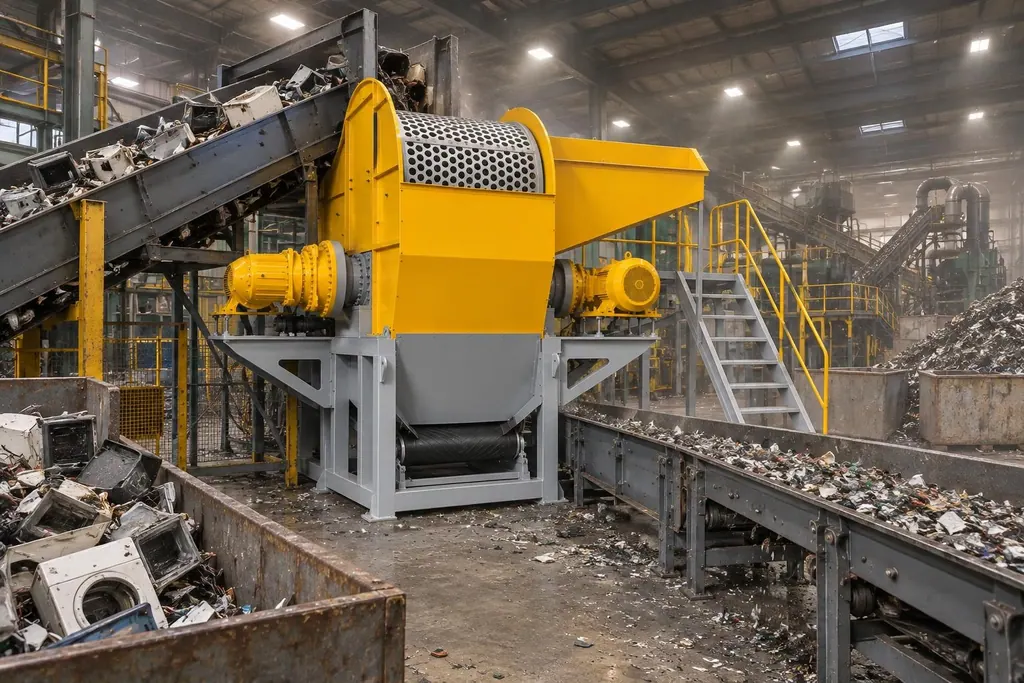
Machine in Action
FAQ
- What is the primary function of a Double-Shaft Shredder in WEEE recycling?
- The Double-Shaft Shredder serves as a primary coarse shredder. Using shear and crush actions between two sets of counter-rotating alloy blades, it shreds and opens mixed, bulky scrap containing metal and hard plastic to feed downstream magnetic and eddy current separators.
- How should the blade hook count be selected on a Double-Shaft Shredder for WEEE processing?
- Hook count depends on feed volume and dimensions. For whole, intact appliances, use single-hook or double-hook blades with deep curvature for forceful intake. If the material is already flattened or roughly dismantled, switch to multi-hook blades to increase cutting speed.
- How does the equipment prevent damage from uncrushable hard objects in mixed WEEE feed?
- Protection relies on current overload auto-reversal controls. When an uncrushable object causes current to spike, the shafts stop and reverse to clear the jam before trying to cut again. If the obstruction persists after set attempts, the unit stops automatically and triggers an alarm for manual removal.