
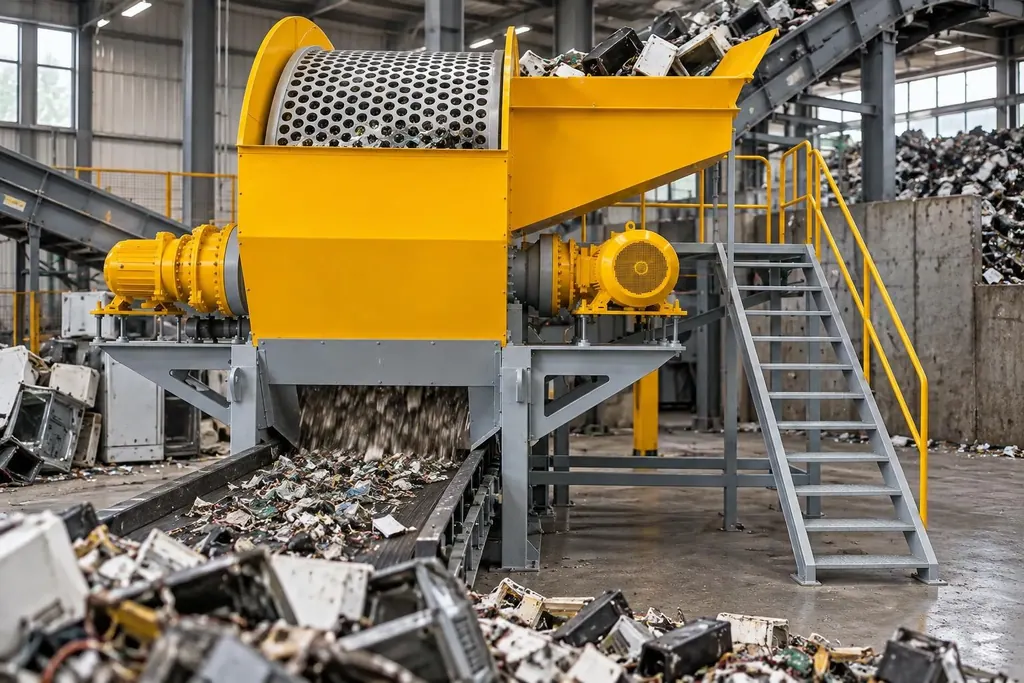
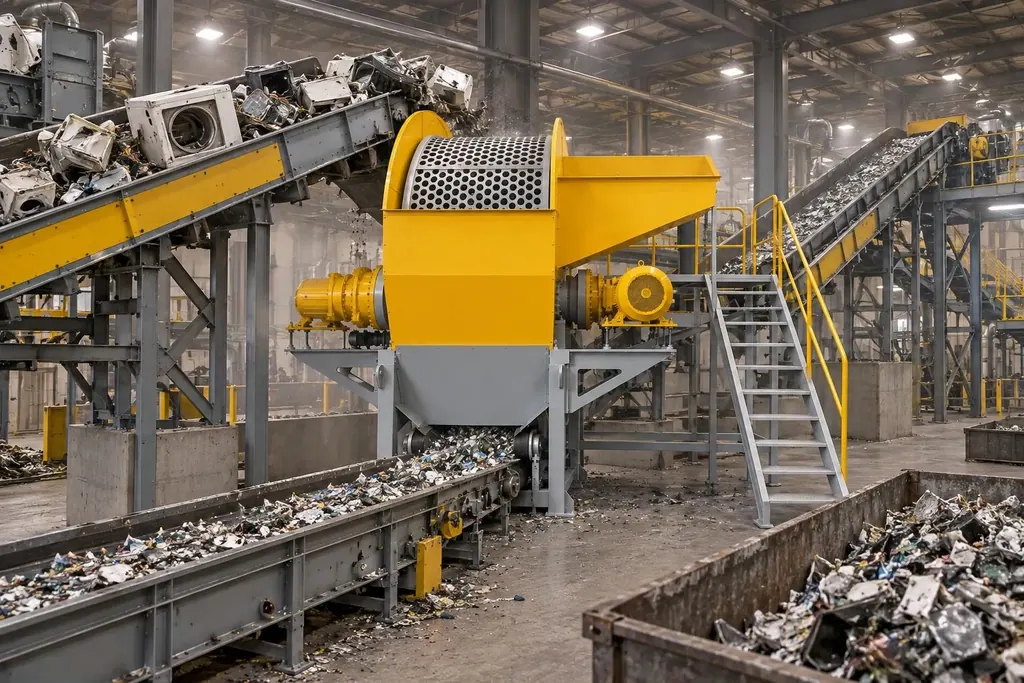
Double-Shaft Shredders handle primary size reduction on WEEE disassembly lines. Two counter-rotating alloy rotor shafts shear and crush discarded refrigerators, air conditioners, washing machines, and television housings into manageable pieces.
WEEE scrap contains a mixed stream of thin sheet metal, engineering plastics, integrated electric motors, and hermetic compressors. Infeed conditions shift without warning. Technicians must inspect cutting engagement, driveline stability, and bearing seals, tracking operating sound, structural deflection, and discharge geometry to assess mechanical integrity.
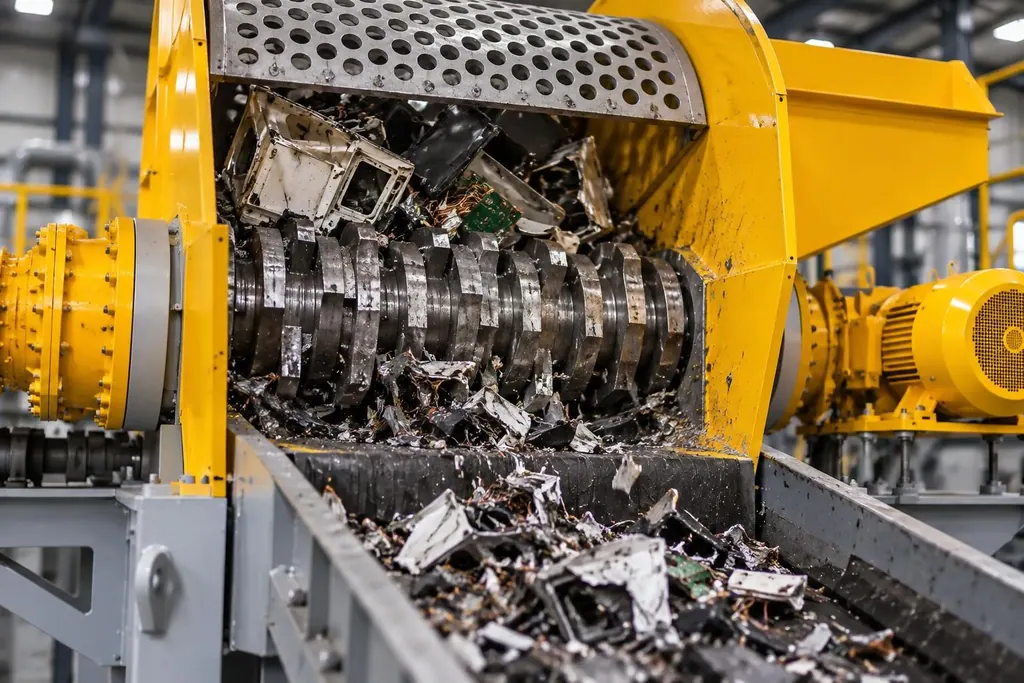
Running shafts can conceal early axial deflection. Measuring knife clearances, logging gearbox temperature rise, and checking bearing housing seals prevent shaft distortion or bearing seizure. Thin-gauge housings call for thin-toothed multi-hook blades. Feeds containing thick plastics or structural shapes perform better with thick-toothed single-hook profiles.
| Equipment type | Applicable material | Process stage | Diagnostic focus |
|---|---|---|---|
| Double-Shaft Shredder | Refrigerator, air conditioner, washing machine, and television housings | Primary size reduction | Clearance between rotor and counter blades controls cut quality; torn or burred discharge scrap indicates excessive gap requiring shimming |
| Double-Shaft Shredder | Mixed appliance scrap containing unshreddables such as compressor pump bodies | Coarse pre-shredding | Do not jog the motor if three auto-reversal cycles fail to clear a jam; lock out power and clear the chamber manually |
Cutting Chamber and Rotor Blade Clearance Checks with Blade Wear Assessment
Isolate power and lock out the shredder before opening the cutting chamber at shift changes. If sheet steel stretches rather than shears cleanly, or if plastic housings show heavy burring and tearing, axial clearance between rotor blades is excessive. Open the housing, measure clearances, and adjust spacer pack compression.
Hook wear patterns define the required corrective step. Rounded hook tips slip during material grab, causing bulky white-goods housings to tumble repeatedly above the rotor shafts instead of drawing down. This confirms dull cutting faces. Operators must apply hardfacing overlays or index cutting edges on site to limit continuous shaft torque spikes.
Stationary counter-knife combs trap material at their base. Tightly packed cabling and polyurethane insulation foam push outward against rotor shaft ends, forcing rotor knives into contact with counter-knife sidewalls. Clean out all counter-knife pockets at every shift shutdown.
Driveline Rotor Alignment and Gearbox Temperature and Vibration Diagnostics
Crushing impacts subject gearboxes and rotor shafts to repeated shock loads. Rapid temperature rise on the bearing bore surface detected via infrared thermometer, or metal-on-metal knocking inside the casing, indicates enlarged gear backlash or thrust bearing damage.
Measuring radial runout during low-speed unloaded test runs confirms shaft straightness. Sheared elastic pins or black rubber dust shed from coupling buffers mean the ends of the two rotor shafts are out of angular alignment. Loosen anchor bolts and align the matching marks again so the gearbox output shaft is not loaded on one side.
Chassis rocking matched to the shredding cycle points to loose anchor bolts or lost rotor balance. Shut down and torque hardware if witness marks shift on the bearing pedestals or gearbox base. For whole appliances with heavy motors, use a hard-tooth helical gearbox with elastic couplings. For plain thin-shell scrap, use a planetary gearbox driven by a hydraulic motor.
Bearing Housing Seal Degradation and Emergency Rotor Jam Diagnostics
Airborne metal fines and abrasive dust migrate toward bearing assemblies. Hardened black grease weeping from bearing covers, or metallic powder collecting around the shaft openings, indicates worn labyrinth seals and raceway contamination. Replace skeleton oil seals and repack with fresh grease during scheduled maintenance shutdowns.
When unshreddable solids or compressor fragments stop the rotor shafts, the automation cabinet triggers automatic reverse cycles to clear the chamber. If three reverse cycles fail to clear the blockage, operators must never jog the forward drive manually. Cut main power, lock out the breaker, open the chamber inspection door, and pry the obstruction free with hand tools.
After clearing the blockage manually, turn the gearbox input shaft one full rotation using a manual barring tool. Verify that rotor knives clear side wear liners without hard binding. Do not close the breaker for unloaded testing or feed material until both shafts rotate smoothly without axial play.
Machine in Action
FAQ
- What is the main function of a Double-Shaft Shredder in a WEEE Recycling Line?
- A Double-Shaft Shredder operates at the head of the processing line for primary reduction. Two interlocking blade shafts pull, shear, and tear bulky appliance housings into palm-sized fragments, preparing the feed stream for downstream magnetic separation of ferrous metals, eddy-current recovery of copper and aluminum, and secondary granulators.
- How do maintenance teams identify when Double-Shaft Shredder blades need hardfacing or replacement?
- Inspect the rotor hook tips during a planned shutdown. If the cutting tips are rounded and slip off infeed scrap, refurbish the profile. If discharged sheet metal shows stretched, torn edges and plastics do not shear through, blade clearances are too wide, requiring edge grinding or spacer adjustments.
- What is the standard procedure when tramp metal jams a Double-Shaft Shredder?
- Allow the electrical control system to complete its automated reverse cycles. If three attempts fail to discharge the material, disconnect main power, apply lock-out tags, open the chamber door, and extract the foreign object manually. Turn the drive shaft one full rotation by hand to confirm free movement before restarting the line.