
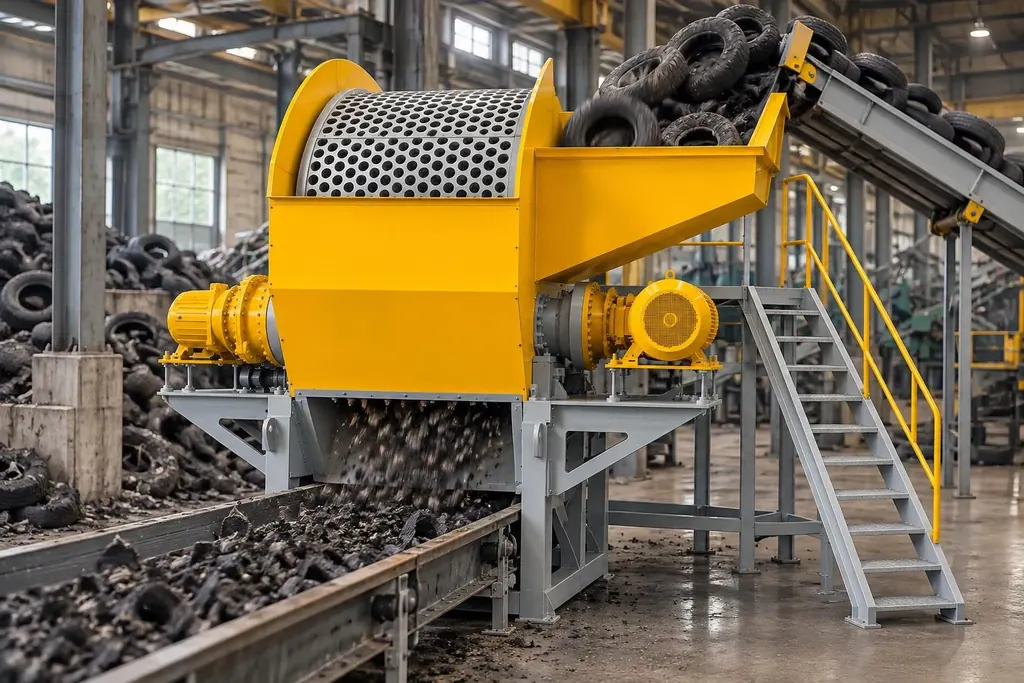
The Double-Shaft Shredder serves as the primary coarse shredding station in a Waste Tire Granule Line. Operating with intermeshed alloy blades and a dual-rotor shearing geometry, the machine cuts, tears, and compresses whole tires, increasing throughput efficiency by more than 40% compared to conventional units.
A scrap tire consists of high-elasticity vulcanized rubber and dense textile cord layers enclosing high-tensile steel beads. Primary shredding equipment takes the direct impact of these thick bead wires, encountering tearing resistance fundamentally distinct from general plastics. Sizing must be evaluated around the impact resistance of low-speed shearing mechanisms rather than the volumetric intake metrics used for municipal solid waste.
Selecting lightweight shredder chambers or tooth profiles suited for brittle materials leads to shaft jamming and frequent auto-reversals under high loads, disrupting downstream line feed rates. Proper coordination of chamber dimensions, alloy blade hardness, and drive train geometry ensures steady coarse shredding operation.
| Machine Section | Core Configuration Target | Scrap Tire Processing Requirement | Selection Metric |
|---|---|---|---|
| Cutter Chamber and Drive Shafts | Dual-rotor shearing assembly with heavy welded frame | Accommodates whole tire diameters and absorbs high shearing shock loads | Increase shaft center distance and frame rigidity for high truck tire volumes |
| Shredding Cutters | Intermeshed alloy blades with wide-edge multi-hook geometry | Wear and impact resistant, cleanly cuts high-tensile bead wires without stringing | Tighten lateral clearance or regrind blades when frayed cords appear |
| Discharge and Protection | Integrated anti-wrapping combs and replaceable wear liners | Prevents fine loose wire from packing into shaft seals and frame gaps | Monitor drop clearances to prevent rubber chips and loose wire from packing underneath |
| Drive System | Precision reduction gearbox paired with heavy-duty bearing assemblies | Handles continuous high-torque loading and absorbs transient shock peaks | Calibrate reversal current thresholds against motor full-load ratings |
Feed Dimensions and Capacity Matching: Shredding Chamber and Shaft Torque Sizing for Primary Tire Shredding
Truck and bus radial tires contain thick, large-diameter bead rings that exert high instantaneous reaction forces upon entering the cutting zone. The hopper opening and internal chamber clear width must accommodate the outer diameter of the largest anticipated tire. The center distance between shafts dictates the grab bite angle; an undersized center distance causes oversized casings to slip and spin on top of the cutters without engaging.
Evaluating production capacity requires matching shear frequency with target output piece sizes. Primary shredding focuses on rapid reduction into coarse chips for downstream fine processing. The Double-Shaft Shredder operates via differential-speed shearing between two shafts, where shaft torque governs the threshold for cutting through bead bundles. On lines processing a high ratio of commercial truck tires, drive torque requires sufficient safety margins to sever bead wires on the initial stroke rather than relying on repeated auto-reversals.
Selection criteria depend on the proportion of heavy commercial tires in the stream. Processing predominantly truck and bus casings requires a shredding chamber fabricated from heavy welded assemblies or thick single-piece side plates. Bearing housings must sit externally at both ends of the chamber to stop rubber fines and wire fragments from migrating into bearing cavities. If processing only passenger car tires, sizing shifts toward optimizing hook engagement frequency to maximize volumetric intake.
Wear and Tensile Demands: Blade Geometry and Anti-Wrapping Wear-Resistant Configurations
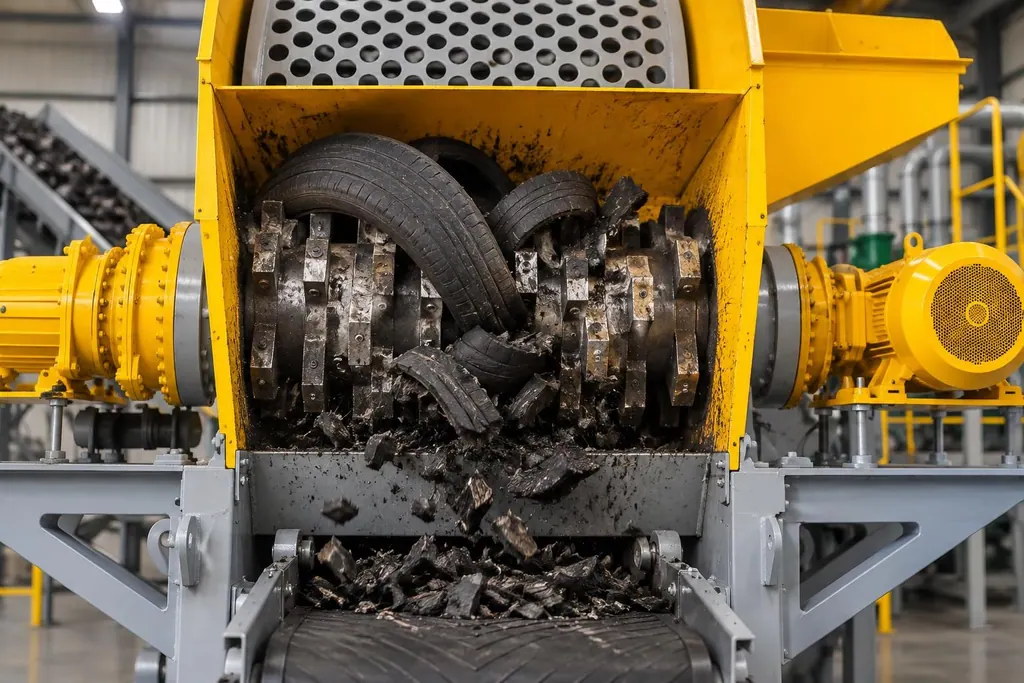
Tire bead wire has extreme hardness, causing standard carbon steel or low-alloy blades to dull and deform after a few hours of continuous operation. Staggered wear-resistant alloy blades retain cutting edges under cyclic alternating loads, eliminating uncut cords that cause material to wrap around the shafts.
Blade tooth count and thickness determine primary chip geometry. Multi-hook designs efficiently grip thin tread sections but experience higher concentrated forces per hook when contacting solid bead wire. Single-hook or double-hook wide designs provide a broader structural base and higher shear impact toughness for handling heavy bead zones. Lateral clearance between intermeshing blades on adjacent shafts requires precision adjustment; excessive lateral gap allows steel wires to wedge sideways, causing abnormal blade face wear and generating parasitic axial thrust along the shafts.
To counter tangled wire fragments, chamber bottoms and side plates require anti-wrapping wear combs. Verifying correct blade configuration involves inspecting cutting edges during downtime for chipped sections or lateral galling. Clean cut edges without ragged textile fibers confirm that blade hardness and bevel angles suit the material mix.
Overload Protection and Service Intervals: Low-Speed High-Torque Drive Train Configuration and Operational Monitoring
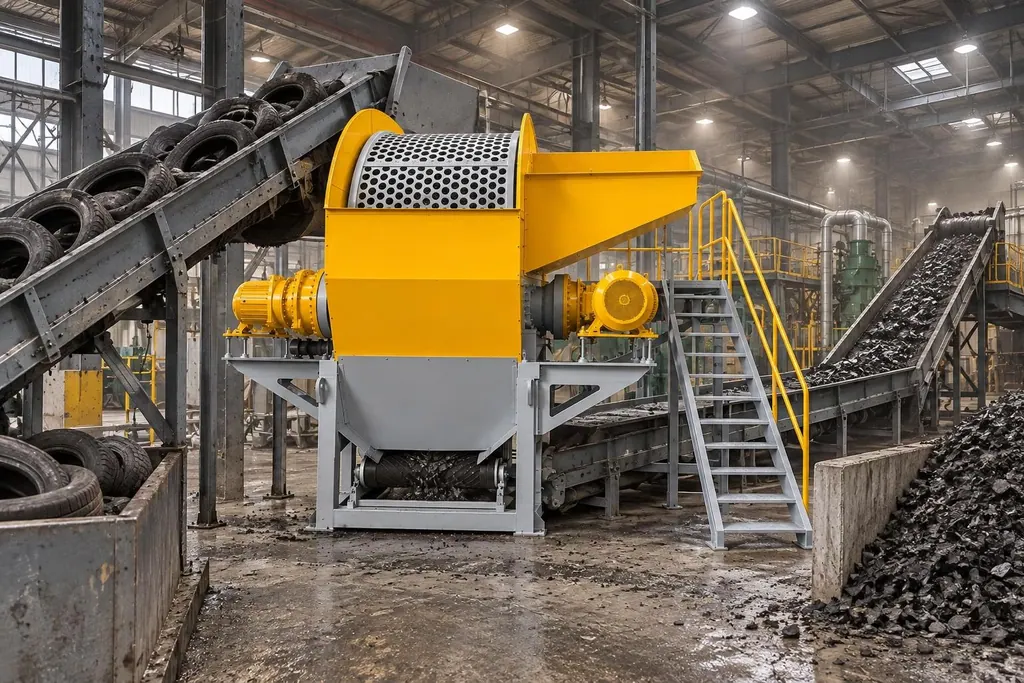
Primary tire reduction involves erratic shock loading. Drive systems pair precision gearboxes with heavy-duty bearing assemblies to sustain continuous high-torque output at low rotational speeds. A precision gearbox dampens mechanical vibration generated when cutting through steel wire cores, insulating the electric motors from shock loads and stabilizing operation during continuous duty.
The overload response logic of the electrical control system determines the service life of mechanical components. When unshreddable tramp metal enters the chamber or bead resistance exceeds preset motor current thresholds, the controller cuts forward drive within milliseconds and triggers an automated reversal to reposition the charge. This sequence prevents motor overheating and reduces fatigue stress on the shafts.
Monitoring drive components requires tracking shaft balance and gearbox housing temperatures. Elevated temperatures at gearbox bearing locations typically indicate excessive side loads from uneven shearing distribution between shafts or continuous off-center chamber feeding. Routine inspection of gear backlash and lubricant condition identifies mechanical wear before failure occurs.
Machine in Action
FAQ
- Is debeading mandatory prior to coarse shredding of scrap tires?
- A Double-Shaft Shredder uses intermeshed alloy cutters with shearing and tearing mechanics capable of direct processing of whole tires containing bead bundles. Removing bead wires from truck tires in advance reduces peak shock loads on shafts and lowers blade wear. The choice to debead depends on plant economics balancing cutter maintenance against upfront labor and machinery costs.
- What factors determine output chip size in a primary Double-Shaft Shredder?
- Output chip dimensions depend on cutter thickness and tooth count. Material shears between the two intermeshing shafts and drops through the cutter clearances. Blade thickness sets chip strip width, while the number of blade hooks controls the segment length.
- How does the equipment protect itself against jams or uncrushable tramp material?
- The system includes an automatic overload protection routine. When encountering an uncrushable object or resistance exceeding safety limits, the controller stops forward rotation and reverses the shafts to back out the blockage. Once the material repositions or operators remove the obstruction, operation resumes without structural damage to the gearbox or shafts.