
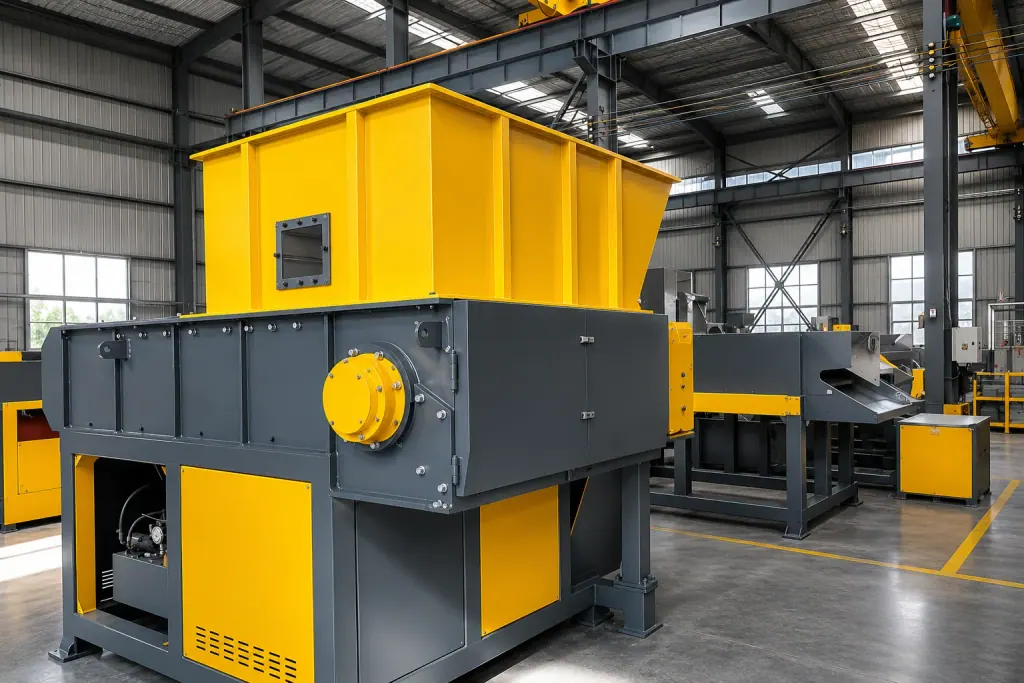
Single-Shaft Shredder units govern particle size in a Waste Cable Recycling Line. A unidirectional rotor drives cutting inserts against fixed bed knives, while an underlying curved screen controls discharge dimensions. The machine mainly handles single-core building wire, stranded flexible copper wire, and automotive harnesses.
Discharge sizing dictates copper-plastic separation purity in downstream air classification and electrostatic systems. Double-Shaft Shredder units lack bottom screens and often allow long, uncut strands to slip through mixed cables. A Single-Shaft Shredder holds material inside the cutting chamber until it passes through the screen.
Machine sizing depends on material spring-back force and cutting resistance. High copper wire ductility exerts counter-force against the ram. Excessive hydraulic pressure trips the main motor on overload, while insufficient pressure permits the cable bundle to bounce off the rotor without engaging the cutters.
| Equipment Type | Feed Specifications | Discharge Particle Size | Key Process Parameters |
|---|---|---|---|
| Single-Shaft Shredder | 0.5-25mm² mixed cable sizes | 3-5mm | Curved bottom screen and horizontal pusher ram for defined sizing |
| Double-Shaft Shredder | Bulky industrial scrap, mixed heavy cables | 30-200mm | High-torque primary shear without bottom screen to clear tramp metal |
| Copper-Plastic Separator | Pre-shredded wire granules | Fine fractions and granules | Dry physical separation, energy consumption <15kW·h/t |
1. Operating Profile and Sizing Control in Cable Pre-Shredding
Processing tangled, flexible wire requires strict control over discharge geometry. The fixed bottom screen blocks uncut strands, eliminating the elongated bypass typical of double-shaft units.
Uneven particle sizes hinder clean liberation of plastic insulation from metal cores, increasing copper carry-over in density tables. Continuous knife passes shear the outer sheath and release the wire core.
Downstream dry gravity separators perform best with a discharge size of 3-5mm. Within this band, density differences between copper and plastic respond cleanly to air currents.
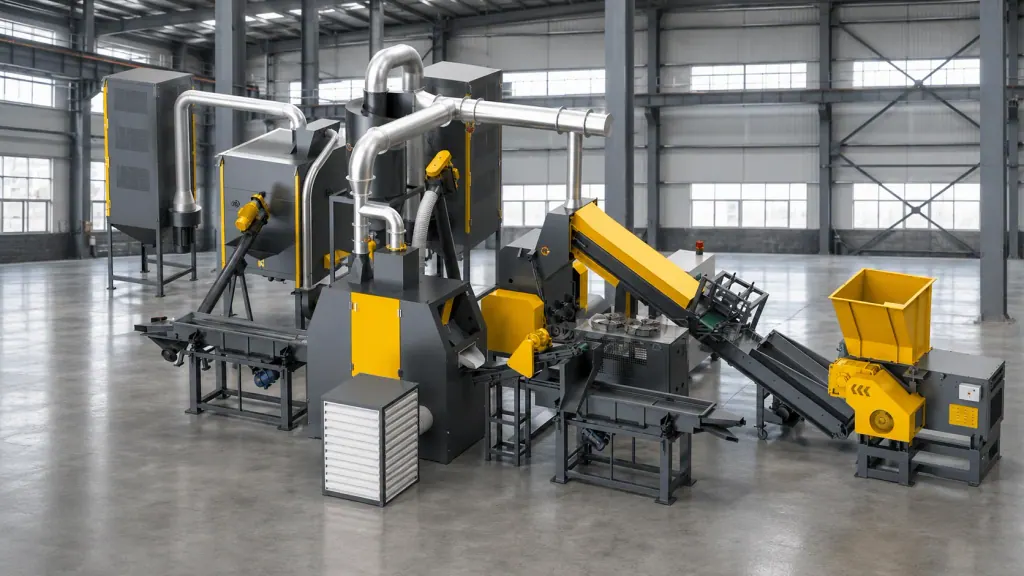
2. Hydraulic Pusher Ram Force and Rotor Cutting Load
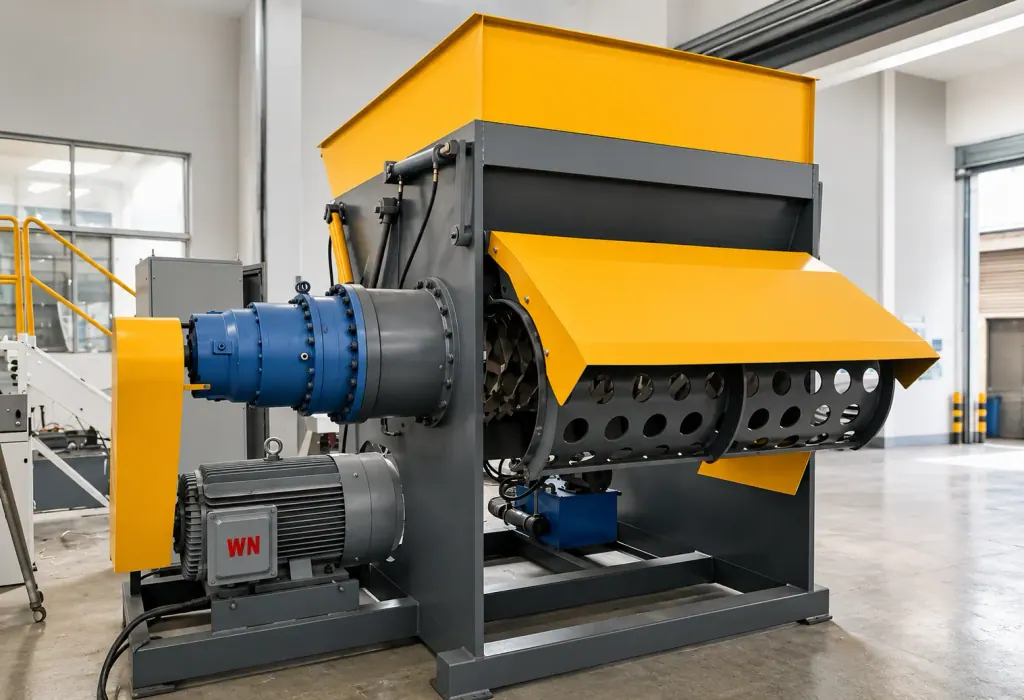
Baled cables present low bulk density and significant spring-back, making the ram load-sensing loop critical. The horizontal pusher guides loose bundles toward the rotor, with advance force directly governed by motor amp draw.
When rotor current reaches a set limit, the ram stops advancing or retracts slightly to prevent packing the knives. As load drops back within nominal parameters, the ram resumes feeding, maintaining uniform throughput without stalling the drive.
Tough wiring bundles tend to ride up on flat pusher plates. Fabricating the ram face with teeth or an angled relief directs lateral force downward, pressing the cables into the rotor cutting path.
3. Screen Mesh Sizing and Anti-Clogging Geometry
Oversized apertures let through long strands that foul conveying pipes. Undersized holes trap fine wires, causing friction heat that melts plastic sheathing and blinds the screen. Screen selection follows the upper particle limit of the downstream separation stage.
Processing 0.5-25mm² scrap wire calls for staggered round or slotted openings. The inner edge of each perforation must retain a sharp profile, allowing the rotor knives to scissor against the screen frame and trim any soft outer jacket.
Hard contaminants gradually round off the leading edges of the screen perforations. Once those edges dull, copper wire wedges into the clearance instead of cutting cleanly, escalating blinding rates and signaling it is time for a screen change.
Machine in Action
FAQ
- Why use a Single-Shaft Shredder for scrap cable processing?
- The curved bottom screen retains long wires inside the cutting chamber until fully reduced. This prevents elongated material from entering downstream systems, producing uniform granules with clean metal liberation.
- What happens if the hydraulic pusher ram applies too much pressure?
- Excessive ram thrust compacts cable bundles against the knives, generating cutting loads that trip the drive motor. Ram advance must be controlled via feedback loops tied to main motor amperage.
- How do you determine the correct screen mesh size?
- Aperture choice depends on the entry requirements of subsequent separation units. For 0.5-25mm² wire, screens producing 3-5mm particles are standard; smaller holes risk melting plastic through frictional heat, while larger holes release oversize strands.