
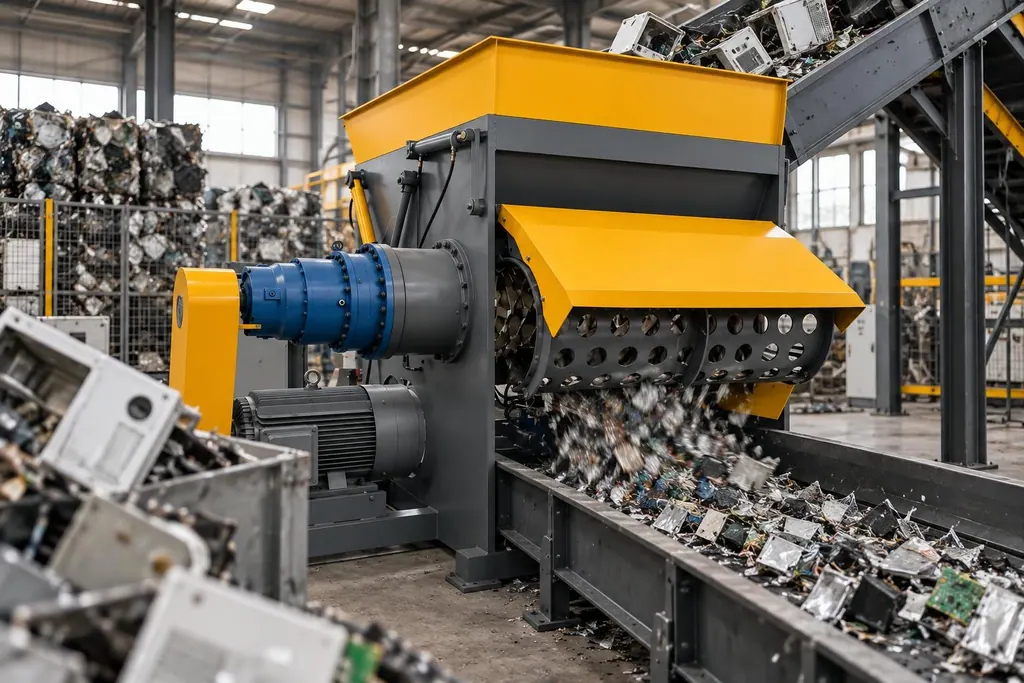
The Single-Shaft Shredder is primary equipment for secondary shredding and material liberation within a WEEE Recycling Line. It uses rotating knives mounted on a high-speed rotor acting against fixed counter-knives to establish a shear cut, paired with a curved bottom screen to control output sizing. The machine handles mixed casings from refrigerators, washing machines, and similar appliances to separate sheet metal from rigid plastics.
Tooling density and screen hole dimensions form the foundation of single-shaft shredder specification. The knife clearance between the counter-knife and rotor knives dictates whether thin sheet metal cuts clean or pulls through, while screen aperture governs the residence time and secondary grinding cycle inside the chamber.
Mismatches between the hydraulic ram force and rotor cutting torque create operating bottlenecks. Excessive feed rates trigger continuous motor overload reversals, whereas low feed pressure allows light scrap to slip along the rotor surface without biting. Balancing knife clearance, screen sizing, and ram feed pressure ensures stable output across the entire WEEE Recycling Line.
| Equipment & Component | Key Configuration Factor | Process Objective | Selection & Adjustment Basis |
|---|---|---|---|
| Single-Shaft Shredder rotor | Spiral knife layout and counter-knife shear gap | Clean cut of thin-gauge metals and brittle fracture of rigid plastics | Tighten shear gap based on casing ductility to stop aluminum and steel wrapping the shaft |
| Single-Shaft Shredder screen | Exchangeable wear-resistant alloy perforated screen plates | Control discharge size and ensure material liberation | Match aperture to downstream magnetic and eddy current units; prevent flake bypass and melt blinding |
| Horizontal hydraulic ram | Load-sensing advance and retract control circuit | Maintain material feed pressure against the rotor cutting zone | Modulate ram speed via drive motor load current; trigger ram retraction on overload spikes |
Influence of Rotor Knife Layout and Counter-Knife Gap on Mixed Scrap Shearing Efficiency
WEEE casing feeds combine thin sheet steel, aluminum trims, and rigid ABS plastic. Tooling choice depends on the ductility profile of this scrap mix. High-ductility light metals compress and deform when running against dull edges or open clearances, while hard plastics shatter through brittle fracture.
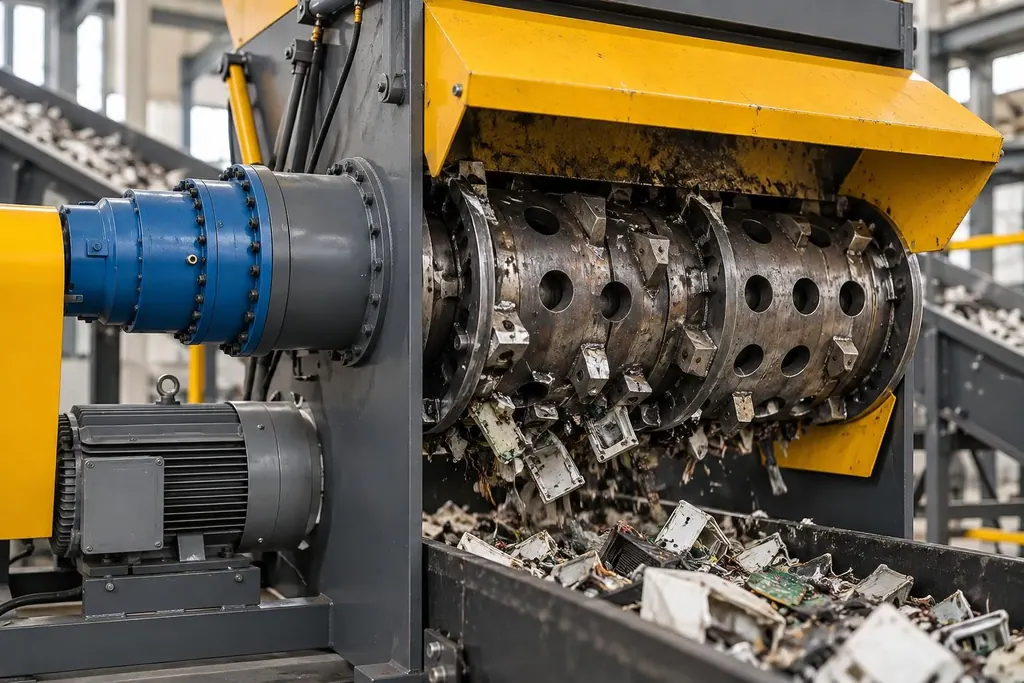
Staggered spiral knife placement across the rotor body distributes instantaneous cutting loads. Tooling clearance must stay tight enough to sheer thin-gauge metals. Excessive gaps draw aluminum and sheet steel directly into the knife bed, wrapping the rotor and forcing shutdowns under motor overload.
Operators should inspect cutting edges regularly. Four-way indexable square inserts can be rotated to fresh cutting faces as edges wear. When processing high volumes of aluminum extrusions and galvanized backplates, indexing intervals drop significantly compared to processing rigid plastics alone. Sharp edges prevent metal drawing and lower heat generation in the shredding chamber.
Screen Aperture Sizing and Discharge Granulometry Standards
Screen hole sizing controls final discharge dimensions, determined by the separation thresholds of downstream sorting equipment. Lines feeding downstream magnetic drums and eddy current separators require complete material liberation without oversized pieces that trap mixed scrap, or excessive fines that cause metal loss.
Undersized apertures trap material in continuous recirculating cuts between the screen and rotor. Friction heat softens plastic casings, smearing polymer over screen perforations, blinding the open area, and driving up power draw. Oversized perforations allow elongated sheet metal to slip through along tangential discharge paths, carrying encapsulated plastic into downstream magnetic separators.
Perforated screens made of wear-resistant alloys are built as multi-piece segments. Given the abrasive nature of WEEE feeds, mounting curved screen sections on fast-exchange slide rails reduces changeout time and protects daily operational uptime across the plant.
Hydraulic Ram Feed Speed and Spindle Load Control Logic
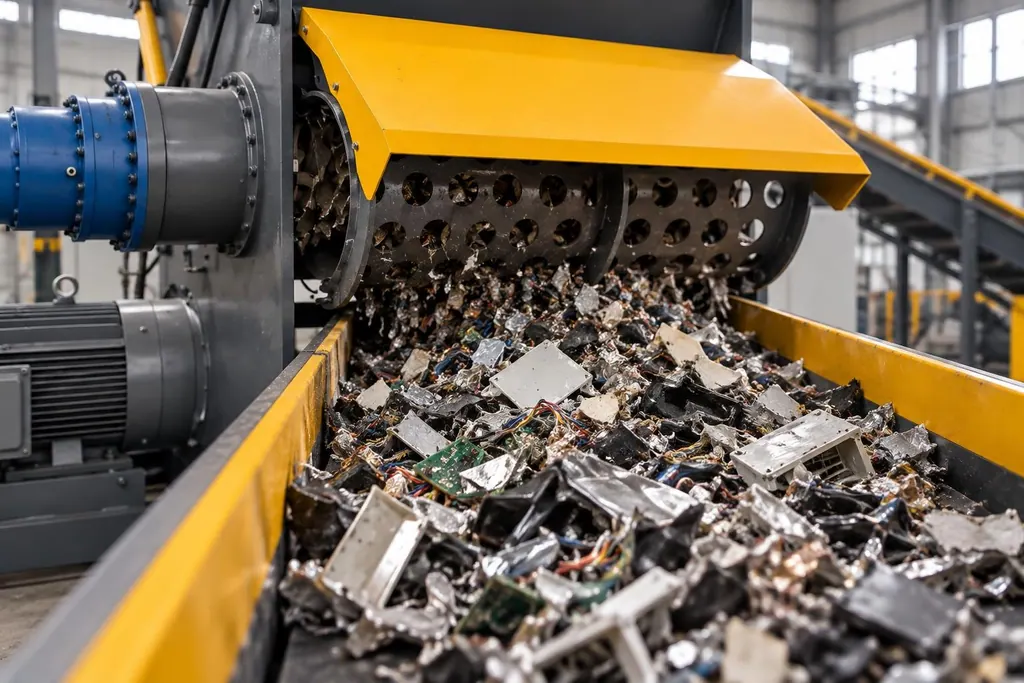
Unlike gravity-fed double-shaft units, a Single-Shaft Shredder relies on a horizontal hydraulic ram to push loose, bulky appliance housings into the cutting circle. Ram sizing and drive selection match the bulk density and deformation resistance of the incoming WEEE scrap.
Ram travel speed modulates against rotor motor current. When the ram pushes dense bundles of sheet scrap into the rotor and motor load climbs, the control loop reduces ram advance velocity. If current exceeds safety limits, the ram retracts a preset stroke length, clearing space for the rotor to clear accumulated scrap before re-engaging forward thrust.
Solid plastic sections or folded structural angle brackets can stall cutting knives under fixed-pressure feeding. Multi-stage pressure regulation paired with stepped retreat logic maintains material contact with the rotor face, preventing the electrical stress of continuous motor start-stops and reversals.
Machine in Action
FAQ
- How do you prevent shredder jams when processing mixed WEEE scrap in a Single-Shaft Shredder?
- Jams typically occur when excessive counter-knife gaps draw sheet metal into the bed, or when aggressive ram feed rates overfill the chamber. The hydraulic ram control must tie into main motor current to automatically slow or retract on load spikes, while the gap between stationary and rotating knives must remain tightly adjusted for clean shearing.
- What happens if the screen aperture is too small in a WEEE Recycling Line?
- Screens with undersized holes trap casing fragments inside the cutting chamber too long. Frictional heat from continuous churning melts plastics, blinding screen openings, increasing electrical draw, accelerating tool wear, and dropping throughput.
- How can operators tell whether Single-Shaft Shredder knives need indexing or replacement?
- Dull knives show up when discharged sheet steel and aluminum display torn, stretched edges instead of clean shears, or when motor load current climbs while maintaining a constant feed rate. Four-way square inserts can be rotated to an unused edge; once all four cutting faces are worn, install new inserts.