
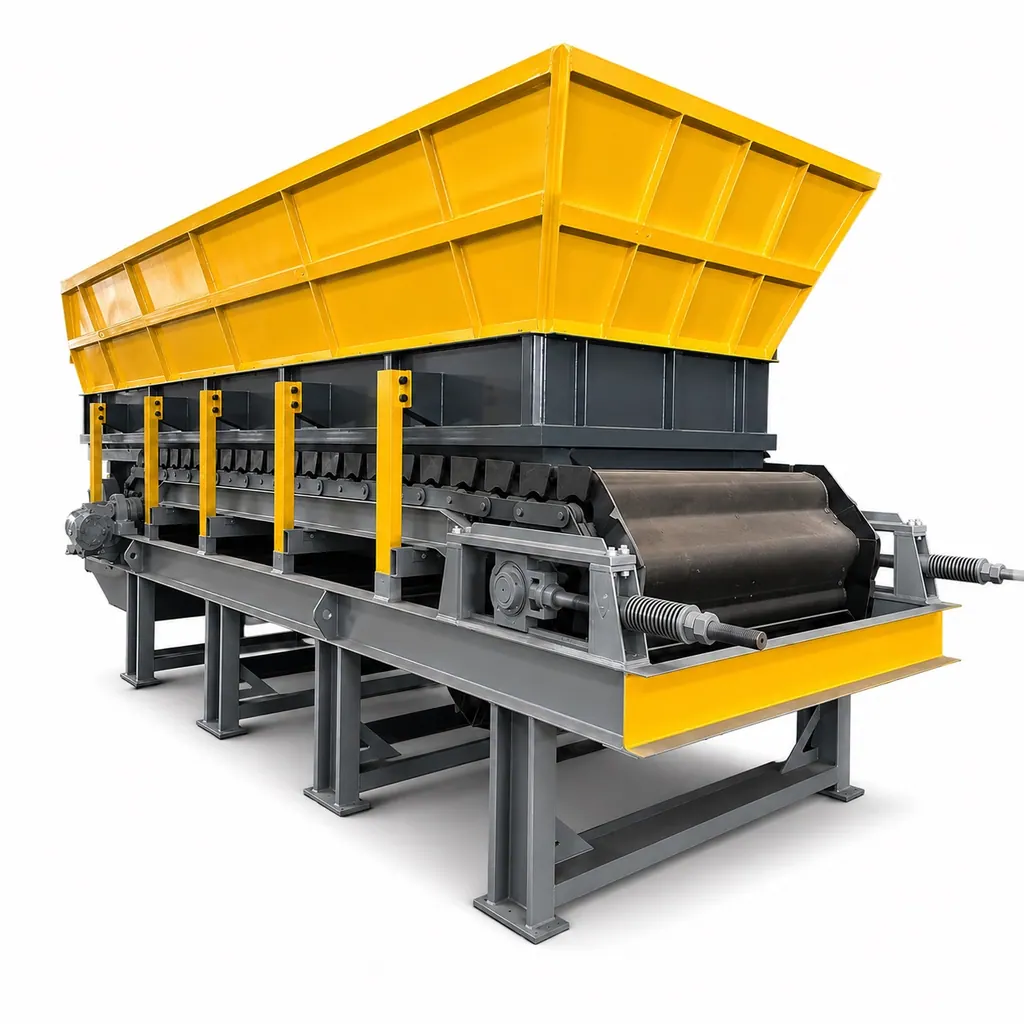
In mining extraction, aggregate production lines, and heavy-duty solid waste crushing systems, the heavy-duty apron feeder serves as the critical primary continuous feeding equipment. It is engineered to withstand the intense impact of large, heavy materials while ensuring uniform and metered feeding into the primary crusher. Proper selection and configuration not only prevent hopper bridging and blockages but also significantly enhance the operational stability and service life of the entire crushing production line.
Structural Composition and Working Principle of Heavy-Duty Apron Feeders
A heavy-duty apron feeder primarily consists of a drive assembly, head sprocket group, tail tensioning group, crawler-type track chains, high-strength stamped or cast heavy-duty apron pans (flights), and a structural steel frame. Its operating principle relies on a geared motor or hydraulic motor driving the head sprockets to rotate, propelling two high-tensile crawler chains and overlapping heavy-duty steel pans mounted on them in a continuous loop along the frame. Material is dumped directly from the overhead hopper onto the apron pans and is continuously conveyed to the discharge end as the pans move forward, discharging smoothly into the downstream crushing equipment. The overlapping design of the apron pans combined with side skirt boards prevents fine material leakage and mechanical jamming.
Three Core Performance Advantages of Heavy-Duty Apron Feeders in Harsh Operating Conditions
Compared with belt conveyors and standard vibrating feeders, heavy-duty apron feeders offer irreplaceable structural advantages when handling highly abrasive, large, and heavy materials:
• High Impact Resistance and Load Capacity: The heavy-duty pan and chain structure directly absorbs the static pressure of tens of tons of hopper load as well as the severe dynamic shock of falling large boulders without risk of jamming or structural deformation.
• Adaptability to Steep Inclines and Complex Materials: Operating reliably at incline angles from 0° up to 25°, it handles high-moisture, sticky, or sharp-edged large ore rocks and scrap metals with ease.
• Accurate Metering and Variable Speed Control: Integrated with Variable Frequency Drives (VFD) or hydraulic speed regulation, the feeding rate can be dynamically adjusted based on downstream crusher loads, enabling intelligent, precise continuous feeding.
Four Essential Technical Parameters for Mining and Crushing Line Feeder Selection
To ensure the heavy-duty apron feeder perfectly matches the capacity requirements of the overall production line, evaluate the following critical technical parameters during selection:
1. Throughput Capacity and Pan Width Configuration: Select pan widths (typically ranging from 1000mm to 2400mm) based on hourly design capacity (t/h) and maximum feed size. The pan width should be at least 2 to 2.5 times the maximum material particle size.
2. Chain and Pan Metallurgy: Opt for cast high-manganese steel or heat-treated alloy steel apron pans paired with crawler-type high-tensile chains to maximize wear resistance and tensile strength.
3. Drive System Options: Standard operating conditions benefit from an electric motor paired with a heavy-duty hardened-gear reducer. For severe applications demanding high torque and frequent heavy-load restarts, low-speed high-torque hydraulic motors are recommended.
4. Incline Angle and Layout Constraints: Inclined installations conserve footprint and lower civil engineering costs. However, steeper incline angles require higher side skirts and a reduced linear operating speed.
Typical Industrial Application Scenarios and Process Flow Layout
Heavy-duty apron feeders are widely utilized underneath primary crushing hoppers in open-pit mines, feeding jaw crushers in aggregate processing lines, at the base of limestone crushers in cement plants, and as primary feeding systems for heavy Double-Shaft Shredder and Hammer Shredder lines. In process layouts, the apron feeder is positioned beneath the receiving hopper to receive raw material dumped from dump trucks or grabs, consistently transferring irregular bulk materials to heavy-duty screens or primary Crushing Equipment to establish a continuous and efficient primary material flow.
Frequently Asked Questions (FAQ) About Heavy-Duty Apron Feeders
Q: How does a heavy-duty apron feeder prevent chain derailment and material jamming during operation? A: The equipment is equipped with dual-side guide rollers and aligned sprocket teeth at the head, paired with screw or hydraulic tensioning devices at the tail to keep the chains running smoothly centered. The overlapping arc-shaped pan design maintains minimal clearance, preventing material traps.
Q: What are the key routine maintenance practices for apron pans and chains? A: Regularly inspect tail chain tension and lubrication conditions, clean out fine dust accumulations from the bottom frame, and periodically verify the pre-tightening torque of the pan mounting bolts.
Q: Can the feeding speed of an apron feeder be adjusted for automated plant control? A: Yes, absolutely. Drive motors are equipped with Variable Frequency Drives (VFD) linked with the current signal of the primary crusher motor. This enables an automated closed-loop system that slows down or stops feeding during crusher overloads and resumes speed once normal operating loads return.